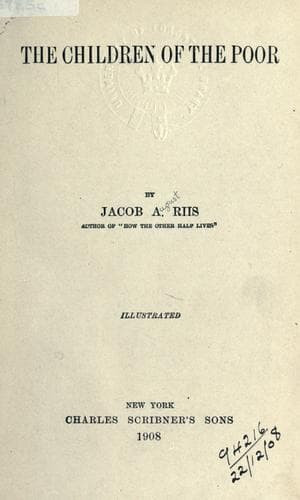
The Children of the PoorRiis, Jacob A. (Jacob August)
History
The Children of the Poor
Riis, Jacob A. (Jacob August)
Child welfare -- New York (State) -- New York; Poor; Poor -- New York (State) -- New York
The vile traffic had been broken up in England only to be transferred to
America. The Italian government had protested. Congress had passed an act
making it a felony for anyone knowingly to bring into the United States
any person inveigled or forcibly kidnapped in any other country, with the
intent to hold him here in involuntary service. But these children were
not only unable to either speak or understand English, they were
compelled, under horrible threats, to tell anyone who asked that the
padrone was their father, brother, or other near relative. To get the
evidence upon which to proceed against the padrone was a task of exceeding
difficulty, but it was finally accomplished by co-operation of the Italian
government with the Society's agents in the case of the padrone Ancarola,
who, in November, 1879, brought over from Italy seven boy slaves, between
nine and thirteen years old, with their outfit of harps and violins. They
were seized, and the padrone, who escaped from the steamer, was arrested
in a Crosby Street groggery five days later. Before a jury in the United
States Court the whole vile scheme was laid bare. One of the boys
testified that Ancarola had paid his mother 20 lire (about four dollars)
and his uncle 60 lire. For this sum he was to serve the padrone four
years. Ancarola was convicted and sent to the penitentiary. The children
were returned to their homes.
The news travelled slowly on the other side. For years the padrone's
victims kept coming at intervals, but the society's agents were on the
watch, and when the last of the kidnappers was sent to prison in 1885
there was an end of the business. The excitement attending the trial and
the vigor with which the society had pushed its pursuit of the rascally
padrone drew increased attention to its work. At the end of the following
year twenty-four societies had been organized in other States upon its
plan, and half the governments of Europe were enacting laws patterned
after those of New York State. To-day there are a hundred societies for
the prevention of cruelty to children in this country, independent of each
other but owning the New York Society as their common parent, and nearly
twice as many abroad, in England, France, Italy, Spain, the West Indies,
South America, Canada, Australia, etc. The old link that bound the dumb
brute with the helpless child in a common bond of humane sympathy has
never been broken. Many of them include both in their efforts, and all the
American societies, whether their care be children or animals, are united
in an association for annual conference and co-operation, called the
American Humane Association.
Public-domain text, read in full here on John Shaqi.
Reviews
Reviews
No reviews yet
Be the first to share your thoughts on this work.
Elsewhere in the archive
Join the Discussion
Join the discussion
Sign in to leave a comment or review.
Sign InorCreate an account