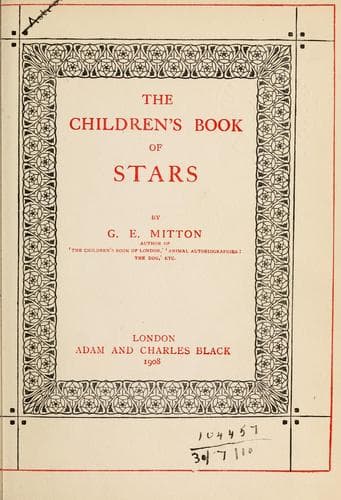
The Children's Book of StarsMitton, G. E. (Geraldine Edith)
Science
The Children's Book of Stars
Mitton, G. E. (Geraldine Edith)
Astronomy -- Juvenile literature
That nebulae do sometimes change we have evidence: there are cases in
which some have grown indisputably brighter during the years they have
been under observation, and some nebulae that have been recorded by
careful observers seem to have vanished. When we consider that these
strange bodies fill many, many times the area of our whole solar system
to the outermost bounds of Neptune's orbit, it is difficult to imagine
what force it is that acts on them to revive or quench their light. That
that light is not the direct result of heat has long been known; it is
probably some form of electric excitement causing luminosity, very much
as it is caused in the comets. Indeed, many people have been tempted to
think of the nebulae as the comets of the universe, and in some points
there are, no doubt, strong resemblances between the two. Both shine in
the same way, both are so faint and thin that stars can be seen through
them; but the spectroscope shows us that to carry the idea too far would
be wrong, as there are many differences in constitution.
We have seen that there are dark stars as well as light stars; if so,
may there not be dark nebulae as well as light ones? It may very well be
so. We have seen that there are reasons for supposing our own system to
have been at first a cool dark nebula rotating slowly. The heavens may
be full of such bodies, but we could not discern them. Their thinness
would prevent their hiding any stars that happened to be behind them. No
evidence of their existence could possibly be brought to us by any
channel that we know.
It is true that, besides the dark rifts in the bright nebulae, which may
themselves be caused by a darker and non-luminous gas, there are also
strange rifts in the Milky Way, which at one time were conjectured to be
due to a dark body intervening between us and the starry background.
This idea is now quite discarded; whatever may cause them, it is not
that. One of the most startling of these rifts is that called the
Coal-Sack, in the Southern Hemisphere, and it occurs in a part of the
sky otherwise so bright that it is the more noticeable. No possible
explanation has yet been suggested to account for it.
Thus it may be seen that, though much has been discovered, much remains
to be discovered. By the patient work of generations of astronomers we
have gained a clear idea of our own position in the universe. Here are
we on a small globe, swinging round a far mightier and a self-luminous
globe, in company with seven other planets, many of which, including
ourselves, are attended by satellites or moons. Between the orbits of
these planets is a ring or zone of tiny bodies, also going round the
sun. Into this system flash every now and then strange luminous
bodies--some coming but once, never to return; others returning again
and again.
Public-domain text, read in full here on John Shaqi.
Reviews
Reviews
No reviews yet
Be the first to share your thoughts on this work.
Elsewhere in the archive
Join the Discussion
Join the discussion
Sign in to leave a comment or review.
Sign InorCreate an account