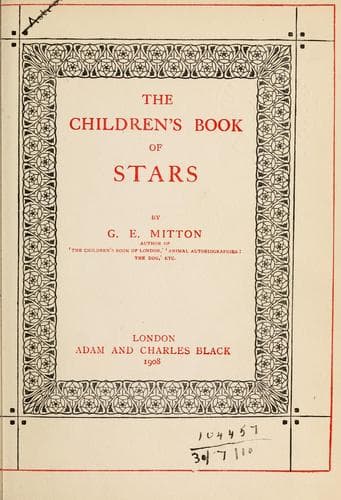
The Children's Book of StarsMitton, G. E. (Geraldine Edith)
Science
The Children's Book of Stars
Mitton, G. E. (Geraldine Edith)
Astronomy -- Juvenile literature
of the new planet, which was called Neptune. The marvel is that by pure
reasoning the mind of man could have achieved such results.
If the observation of Uranus is difficult, how much more that of
Neptune, which is still further plunged in space! Yet by patience a few
facts have been gleaned about him. He is not very different in size from
Uranus. He also is of very slight density. His year includes one hundred
and sixty-five of ours, so that since his discovery in 1846 he has only
had time to get round less than a third of his path. His axis is even
more tilted over than that of Uranus, so that if we compare Uranus to a
top held horizontally, Neptune will be like a top with one end pointing
downwards. He rotates in this extraordinary position, in the same manner
as Uranus--namely, the other way over from all the other planets, but he
revolves, as they all do, counter-clockwise.
Seen from Neptune the sun can only appear about as large as Venus
appears to us at her best, and the light and heat received are but one
nine-hundreth part of what he sends us. Yet so brilliant is sunshine
that even then the light that falls on Neptune must be very
considerable, much more than that which we receive from Venus, for the
sun itself glows, and from Venus the light is only reflected. The sun,
small as it must appear, will shine with the radiance of a glowing
electric light. To get some idea of the brilliance of sunlight, sit near
a screen of leaves on some sunny day when the sun is high overhead, and
note the intense radiance of even the tiny rays which shine through the
small holes in the leaves. The scintillating light is more glorious than
any diamond, shooting out coloured rays in all directions. A small sun
the apparent size of Venus would, therefore, give enough light for
practical purposes to such a world as Neptune, even though to us a world
so illuminated would seem to be condemned to a perpetual twilight.
CHAPTER VII
THE SUN
Public-domain text, read in full here on John Shaqi.
Reviews
Reviews
No reviews yet
Be the first to share your thoughts on this work.
Elsewhere in the archive
Join the Discussion
Join the discussion
Sign in to leave a comment or review.
Sign InorCreate an account