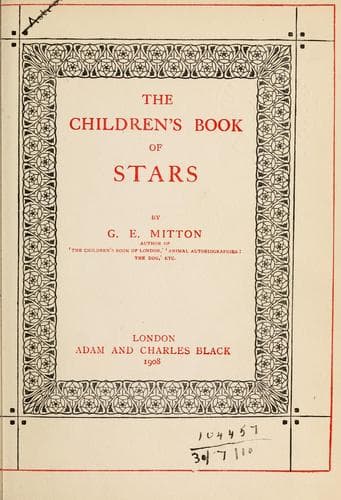
The Children's Book of StarsMitton, G. E. (Geraldine Edith)
Science
The Children's Book of Stars
Mitton, G. E. (Geraldine Edith)
Astronomy -- Juvenile literature
The discovery of Uranus filled the whole civilized world with wonder.
The astronomers who had seen him, but missed finding out that he was a
planet, must have felt bitterly mortified, and when he was discovered he
was observed with the utmost accuracy and care. The calculations made to
determine his path in the sky were the easier because he had been noted
as a star in several catalogues previously, so that his position for
some time past was known. Everybody who worked at astronomy began to
observe him. From these facts mathematicians set to work, and, by
abstruse calculations, worked out exactly the orbit in which he ought to
move; then his movements were again watched, and behold he followed the
path predicted for him; but there was a small difference here and there:
he did not follow it exactly. Now, in the heavens there is a reason for
everything, though we may not always be clever enough to find it out,
and it was easily guessed that it was not by accident that Uranus did
not precisely follow the path calculated for him. The planets all act
and react on one another, as we know, according to their mass and their
distance, and in the calculations the pull of Jupiter on Saturn and of
Saturn on Uranus were known and allowed for. But Uranus was pulled by
some unseen influence also.
A young Englishman named Adams, by some abstruse and difficult
mathematical work far beyond the power of ordinary brains, found out not
only the fact that there must be another planet nearly as large as
Uranus in an orbit outside his, but actually predicted where such a
planet might be seen if anyone would look for it. He gave his results to
a professor of astronomy at Cambridge. Now, it seems an easy thing to
say to anyone, 'Look out for a planet in such and such a part of the
sky,' but in reality, when the telescope is turned to that part of the
sky, stars are seen in such numbers that, without very careful
comparison with a star chart, it is impossible to say which are fixed
stars and which, if any, is an intruder. There happened to be no star
chart of this kind for the particular part of the sky wanted, and thus a
long time elapsed and the planet was not identified. Meantime a young
Frenchman named Leverrier had also taken up the same investigation, and,
without knowing anything of Adams' work, had come to the same
conclusion. He sent his results to the Berlin Observatory, where a star
chart such as was wanted was actually just being made. By the use of
this the Berlin astronomers at once identified this new member of our
system, and announced to the astonished world that another large planet,
making eight altogether, had been discovered. Then the English
astronomers remembered that they too held in their hands the means for
making this wonderful discovery, but, by having allowed so much time to
elapse, they had let the honour go to France. However, the names of
Adams and Leverrier will always be coupled together as the discoverers
Public-domain text, read in full here on John Shaqi.
Reviews
Reviews
No reviews yet
Be the first to share your thoughts on this work.
Elsewhere in the archive
Join the Discussion
Join the discussion
Sign in to leave a comment or review.
Sign InorCreate an account