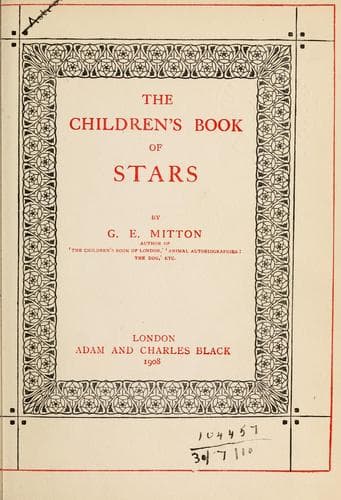
The Children's Book of StarsMitton, G. E. (Geraldine Edith)
Science
The Children's Book of Stars
Mitton, G. E. (Geraldine Edith)
Astronomy -- Juvenile literature
So far we have supposed that the planets were all on what we should call
a level--that is to say, we have regarded them as if they were floating
in a sea of water around the sun; but this is only approximately
correct, for the orbits of the planets are not all at one level. If you
had a number of slender hoops or rings to represent the planetary
orbits, you would have to tilt one a little this way and another a
little that way, only never so far but that a line through the centre
of the hoop from one side to another could pass through the sun. The way
in which the planetary orbits are tilted is slight in comparison with
that of the orbits of comets, for these are at all sorts of angles--some
turned almost sideways, and others slanting, and all of them are
ellipses long drawn out and much more irregular than the planetary
orbits; but erratic as they are, in every case a line drawn through the
sun and extended both ways would touch each side of the orbits.
A great astronomer called Halley, who was born in the time of the
Commonwealth, was lucky enough to see a very brilliant comet, and the
sight interested him so much that he made all the calculations necessary
to find out just in what direction it was travelling in the heavens. He
found out that it followed an ellipse which brought it very near to the
sun at one part of its journey, and carried it far beyond the orbit of
the earth, right out to that of Neptune, at the other. Then he began to
search the records for other comets which had been observed before his
time. He found that two particularly bright ones had been carefully
noted--one about seventy-five years before that which he had seen, and
the other seventy-five years before that again. Both these comets had
been watched so scientifically that the paths in which they had
travelled could be computed. A brilliant inspiration came to Halley. He
believed that instead of these three, his own and the other two, being
different comets, they were the same one, which returned to the sun
about every seventy-five years. This could be proved, for if this idea
were correct, of course the comet would return again in another
seventy-five years, unless something unforeseen occurred. But Halley was
in the prime of life: he could not hope to live to see his forecast
verified. The only thing he could do was to note down exact particulars,
by means of which others who lived after him might recognize his comet.
And so when the time came for its return, though Halley was in his
grave, numbers of astronomers were watching eagerly to see the
fulfilment of his prediction. The comet did indeed appear, and since
then it has been seen once again, and now we expect it to come back in
the year 1910, when you and I may see it for ourselves. When the
identity of the comet was fully established men began to search further
back still, to compare the records of other previous brilliant comets,
and found that this one had been noticed many times before, and once as
Public-domain text, read in full here on John Shaqi.
Reviews
Reviews
No reviews yet
Be the first to share your thoughts on this work.
Elsewhere in the archive
Join the Discussion
Join the discussion
Sign in to leave a comment or review.
Sign InorCreate an account