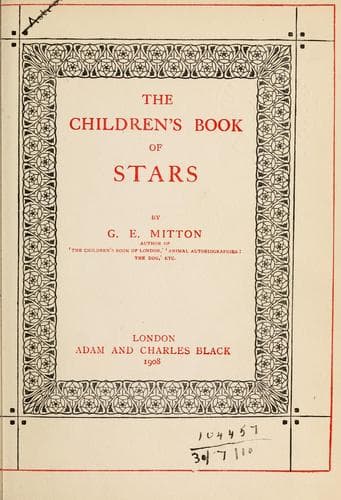
The Children's Book of StarsMitton, G. E. (Geraldine Edith)
Science
The Children's Book of Stars
Mitton, G. E. (Geraldine Edith)
Astronomy -- Juvenile literature
remote that we cannot even dream of it--far away into cold more
appalling than anything we could measure, the cold of absolute space.
More and more slowly it travels, always away and away, until the sun, a
short time back a huge furnace covering all the sky, is now but a faint
star. Thus on its lonely journey unseen and unknown the comet goes.
This comet which we have taken as an illustration is a typical one, but
all are not the same. Some have no tails at all, and never develop any;
some change utterly even as they are watched. The same comet is so
different at different times that the only possible way of identifying
it is by knowing its path, and even this is not a certain method, for
some comets appear to travel at intervals along the same path!
Now we come to the question that must have been in the mind of everyone
from the beginning of this chapter, What are comets? This question no
one can answer definitely, for there are many things so puzzling about
these strange appearances that it is difficult even to suggest an
explanation. Yet a good deal is known. In the first place, we are
certain that comets have very little density--that is to say, they are
indescribably thin, thinner than the thinnest kind of gas; and air,
which we always think so thin, would be almost like a blanket compared
with the material of comets. This we judge because they exercise no sort
of influence on any of the planetary bodies they draw near to, which
they certainly would do if they were made of any kind of solid matter.
They come sometimes very close to some of the planets. A comet was so
near to Jupiter that it was actually in among his moons. The comet was
violently agitated; he was pulled in fact right out of his old path, and
has been going on a new one ever since; but he did not exercise the
smallest effect on Jupiter, or even on the moons. And, as I said earlier
in this chapter, we on the earth have been actually in the folds of a
comet's tail. This astonishing fact happened in June, 1861. One evening
after the sun had set a golden-yellow disc, surrounded with filmy
wrappings, appeared in the sky. The sun's light, diffused throughout
our atmosphere, had prevented its being seen sooner. This was apparently
the comet's head. It is described as 'though a number of light, hazy
clouds were floating around a miniature full moon.' From this a cone of
light extended far up into the sky, and when the head disappeared below
the horizon this tail was seen to reach to the zenith. But that was not
all. Strange shafts of light seemed to hang right overhead, and could
only be accounted for by supposing that they were caused by another tail
hanging straight above us, so that we looked up at it foreshortened by
perspective. The comet's head lay between the earth and the sun, and its
tail, which extended over many millions of miles, stretched out behind
in such a way that the earth must have gone right through it. The fact
Public-domain text, read in full here on John Shaqi.
Reviews
Reviews
No reviews yet
Be the first to share your thoughts on this work.
Elsewhere in the archive
Join the Discussion
Join the discussion
Sign in to leave a comment or review.
Sign InorCreate an account