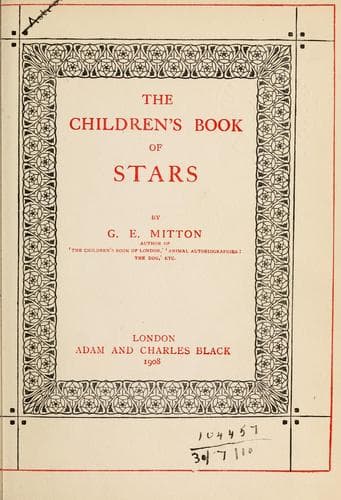
The Children's Book of StarsMitton, G. E. (Geraldine Edith)
Science
The Children's Book of Stars
Mitton, G. E. (Geraldine Edith)
Astronomy -- Juvenile literature
Now, light is also caused by waves, but they are not the same as sound
waves. Light travels without air, whereas sound we know cannot travel
without air, and is ever so much slower, and altogether a grosser,
clumsier thing than light. But yet the waves or rays which make light
correspond in some ways to the vibrations of sound. What corresponds to
the treble on the piano is the blue end of the spectrum in light, and
the bass is the red end. Now, when we are looking at the spectrum of
any body which is advancing swiftly toward us, something of the same
effect is observed as in the case of the shrieking engine. Take any star
and imagine that that star is hastening toward us at a pace of three
hundred miles a second, which is not at all an unusual rate for a star;
then, if we examine the band of light, the spectrum, of such a star, we
shall observe an extraordinary fact--all these little lines we have
spoken of are shoved up toward the treble or blue end of the spectrum.
They still remain just the same distances from each other, and are in
twos and threes or single, so that the whole set of lines is unaltered
as a set, but everyone of them is shifted a tiny fraction up toward the
blue end of the spectrum, just a little displaced. Now if, instead of
advancing toward us, this same star had been rushing away from us at a
similar pace, all these lines would have been moved a tiny bit toward
the red or bass end of the spectrum. This is known to be certainly true,
so that by means of the spectroscope we can tell that some of these
great sun-stars are advancing toward us and some receding from us,
according to whether the multitudes of little lines in the spectrum are
shifted slightly to the blue or the red end.
You remember that it has been surmised that the pace the sun moves with
his system is about twelve miles a second. This seems fast enough to us,
who think that one mile a minute is good time for an express train, but
it is slow compared with the pace of many of the stars. As I have said,
some are travelling at a rate of between two hundred and three hundred
miles a second; and it is due to the spectroscope that we know not only
whether a star is advancing toward us or receding from us, but also
whether the pace is great or not; it even tells us what the pace is, up
to about half a mile a second, which is very marvellous. It is a curious
fact that many of the small stars show greater movement than the large
ones, which mayor may not mean that they are nearer to us.
Public-domain text, read in full here on John Shaqi.
Reviews
Reviews
No reviews yet
Be the first to share your thoughts on this work.
Elsewhere in the archive
Join the Discussion
Join the discussion
Sign in to leave a comment or review.
Sign InorCreate an account