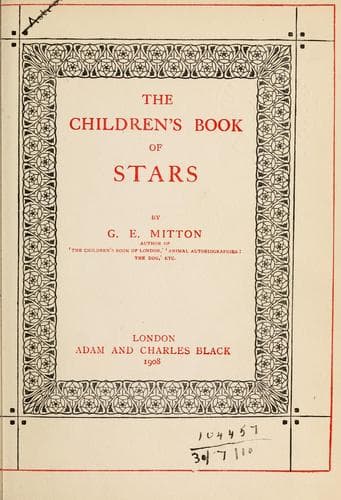
The Children's Book of StarsMitton, G. E. (Geraldine Edith)
Science
The Children's Book of Stars
Mitton, G. E. (Geraldine Edith)
Astronomy -- Juvenile literature
With the unaided eye we see comparatively few stars in the Pleiades. Six
is the usual number to be counted, though people with very good sight
have made out fourteen. Viewed through the telescope, however, the scene
changes: into this part of space stars are crowded in astonishing
profusion; it is impossible to count them, and with every increase in
the power of the telescope still more are revealed. Well over a thousand
in this small space seems no exaggerated estimate. Now, it is impossible
to say how many of these really belong to the group, and how many are
seen there accidentally, but observations of the most prominent ones
have shown that they are all moving in exactly the same direction at
the same pace. It would be against probability to conceive that such a
thing could be the result of mere chance, considering the infinite
variety of star movements in general, and so we are bound to believe
that this wonderful collection of stars is a real group, and not only an
apparent one.
So splendid are the great suns that illuminate this mighty system, that
at least fifty or sixty of them far surpass our own sun in brilliancy.
Therefore when we look at that tiny sparkling group we must in
imagination picture it as a vast cluster of mighty stars, all controlled
and swayed by some dominant impulse, though separated by spaces enough
to make the brain reel in thinking of them. If these suns possess also
attendant planets, what a galaxy of worlds, what a universe within a
universe is here!
Other star clusters there are, not so conspicuous as the Pleiades, and
most of these can only be seen through a telescope, so we may be
thankful that we have one example so splendid within our own vision.
There are some clusters so far and faintly shining that they were at
first thought to be nebulae, and not stars at all; but the telescope
gradually revealed the fact that many of these are made up of stars,
and so people began to think that all faint shining patches of nebulous
light were really star clusters, which would be resolved into stars if
only we had better telescopes. Since the invention of the spectroscope,
however, fresh light has been thrown on the matter, for the spectrum
which is shown by some of the nebulous patches is not the same as that
shown by stars, and we know that many of these strange appearances are
not made up of infinitely distant stars.
Public-domain text, read in full here on John Shaqi.
Reviews
Reviews
No reviews yet
Be the first to share your thoughts on this work.
Elsewhere in the archive
Join the Discussion
Join the discussion
Sign in to leave a comment or review.
Sign InorCreate an account