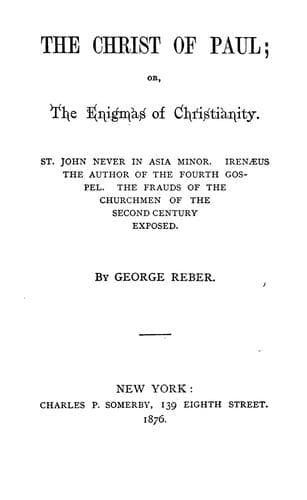
The Christ of Paul; Or, The Enigmas of ChristianityReber, George
Religion
The Christ of Paul; Or, The Enigmas of Christianity
Reber, George
Bible. New Testament -- Controversial literature; Church history -- Primitive and early church, ca. 30-600 -- Controversial literature
Throughout these two chapters Paul shows deep sorrow on account of
the progress of the new faith, and with his expressions of regret, he
mingles words of reproof. The troubles growing out of it followed him
through life. They harassed him in his prison. He lived to see all Asia
turned away from him. With an aching heart he makes one last request
of Timothy: "And the things that thou hast heard of me among many
witnesses, the same commit thou to faithful men, who shall be able to
teach others also." (2 _Tim_. ii. 2.)
CHAPTER XXVI.
The controversy between Ptolemæus and Irenæus as to the
length of Christ's ministry.--Christ was in Jerusalem but
once after he began to preach, according to the first three
Gospels, but three times according to John.--If the
statements made in the first three are true, everything
stated in the fourth could only happen after the death of
Christ.
It will be remembered that Ptolemæus asserted that the time of Christ's
ministry did not exceed the period of one year. This drove Irenæus to
claim that it continued for the space of ten years, on the authority
of a tradition derived from John. The precise time when, and what,
Ptolemæus wrote, we have no means in our day of finding out; for his
writings, like all those of the Gnostics, doubtless perished under
the destructive edict of the Emperor Constantine. We are at liberty to
conclude that he wrote before the fourth Gospel appeared, as he limits
the time to one year, which agrees in that respect with the Synoptics.
Had he had any knowledge of the fourth Gospel, he might, by adopting the
mode of reasoning on this subject used by the orthodox, have made the
time three years instead of one. It will be noted that Irenaeus, in his
controversy with Ptolemaeus, makes no mention of the fourth Gospel, but
falls back on a tradition. In a dispute with a sharp-witted adversary,
he found it safer to rely on a tradition, as evasive as the mirage of
the desert, than the authority of the fourth book of John. The reason
for this preference will be readily seen when the subject is understood.
According to Matthew, after the temptation in the wilderness, Christ
returned to Nazareth, in Galilee. He left Nazareth and came and dwelt
in Capernaum, in the borders of Zabulon and Nephthalim, as spoken by
Esaias: "The land of Zabulon and the land of Nephthalim, by the way of
the sea, beyond Jordan, Galilee of the Gentiles. The people which sat in
darkness saw great light; and to them which sat in the region and shadow
of death light is sprung up. _From that time Jesus began to preach, and
to say, Repent: for the kingdom of heaven is at hand_." (Chapter iv. 15,
16, 17.)
Public-domain text, read in full here on John Shaqi.
Reviews
Reviews
No reviews yet
Be the first to share your thoughts on this work.
Elsewhere in the archive
Join the Discussion
Join the discussion
Sign in to leave a comment or review.
Sign InorCreate an account