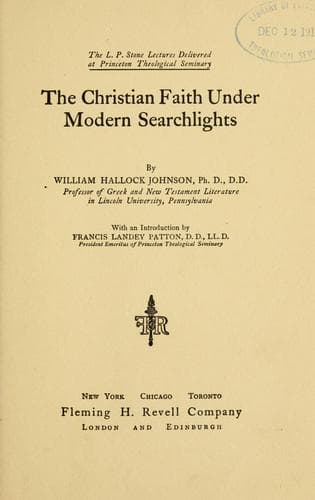
The Christian Faith Under Modern SearchlightsJohnson, William Hallock
Religion
The Christian Faith Under Modern Searchlights
Johnson, William Hallock
Modernism (Christian theology)
4. (According to Bousset) Mark's abbreviation of Q in iii. 27 makes it
appear that it was Jesus who bound the strong man, instead of God.[283]
283: "Kyrios Christos," p. 49.
5. Matthew xiii. 55, "Is not this the carpenter's son?" Compare Luke iv.
22, "Is not this Joseph's son?" Mark vi. 3, "Is not this the carpenter,
the son of Mary?" Belief in the Virgin Birth is perhaps safeguarded by
Mark.
6. Mark x. 45, "The Son of man came not to be ministered unto, etc."
Here Bousset sees a dogmatic working over of Luke xxii. 27, "I am among
you as one that serves."[284] Matthew xx. 28 follows Mark.
284: "Kyrios Christos," p. 9, note 1.
So far as tendency to Christological heightening is concerned, critics
of the school of Bousset are now especially severe against Mark. It
appears that "Luke's Gospel in the Passion history has preserved a
series of primary traditions over against Mark."[285] Holdsworth finds a
number of secondary elements, mostly stylistic, in Mark where the three
Gospels have a common narrative. Among these are the vivid touches of
the second Gospel, considered to be "distinctly secondary features," the
fuller descriptions in many instances, and the use of the noun "gospel"
not found at all in Luke although the verb is used, and not found in
Matthew in its absolute sense.[286]
285: "Kyrios Christos," p. 44.
286: "Gospel Origins," pp. 118 f.
Taking, then, the present state of opinion as to the relation of our
Mark to the other Gospels, we see that while in general the "priority of
Mark" is in some sense defended, yet the relation between any given
passage in Matthew or Luke and its parallel in Mark may be variously
construed. When Matthew, for example, deviates from Mark, this
modification according to current theories may arise (1) from the first
Evangelist's fancy or his dogmatic tendency, and will in either case be
historically worthless. It may arise (2) from reliable oral tradition,
and in this case be as worthy of credence as the Markan source. It may
be derived (3) from the source Q, but may be for some reason omitted by
Mark, whose knowledge of Q is assumed. The deviation in Matthew may (4)
have been found in a proto- or deutero-Mark, but have been omitted in his
final edition. The difference in this case between Matthew and Mark is
no greater than that between two editions of the same work.
Public-domain text, read in full here on John Shaqi.
Reviews
Reviews
No reviews yet
Be the first to share your thoughts on this work.
Elsewhere in the archive
Join the Discussion
Join the discussion
Sign in to leave a comment or review.
Sign InorCreate an account