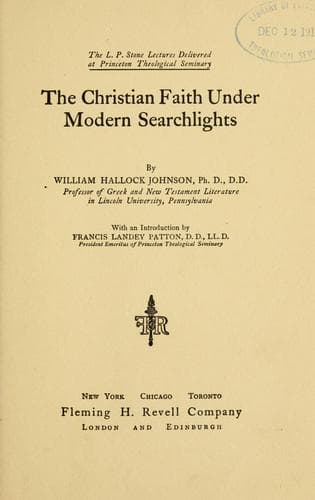
The Christian Faith Under Modern SearchlightsJohnson, William Hallock
Religion
The Christian Faith Under Modern Searchlights
Johnson, William Hallock
Modernism (Christian theology)
Whatever the literary foundation of the two-document theory, it cannot
be said to have led to any very important historical results. Those who
regard the portrait of Jesus in Mark as historical see in the portrayal
of Matthew and Luke only a difference in the _nuances_ of the narrative.
On the other hand, those who cannot accept the picture drawn by the
First and the Third Evangelists are equally unable to accept that given
to us by Mark. The criticism of the sources, in its usual form, has not
revealed to us a Jesus who is more historical than the Jesus of any of
the Synoptists; and it is necessary to pursue the quest in the more
problematical region of "sources of sources." In this process Mark is
found to be as little historical as the other Synoptic Gospels, or even
as the Gospel of John.
The "dissonances of the Evangelists" appear to be left practically where
they were before the present movement in Synoptic criticism began. They
remain what they always have been when one Gospel is compared with
another, and are neither softened nor made more acute by any certain
results which have been reached in the study of the Synoptic problem.
Some, no doubt, may say that the discrepancies are so great that the
Synoptic Gospels cannot be accepted as historical records; while others
will say, as does a devout commentator on the Acts, that "such is the
naturalness of Holy Scripture that it seems as though it were
indifferent about a superficial consistency. So it ever is with truth:
its harmony is often veiled and hidden; while falsehood sometimes
betrays itself, to a practised ear, by a studied and ostentatious
uniformity."[289] Others again will appeal to the writers on historical
method, such as Langlois and Seignobos: "The natural tendency is to
think that the closer the agreement is, the greater is its demonstrative
power; we ought, on the contrary, to adopt as a rule the paradox that an
agreement proves more when it is confined to a small number of
circumstances. It is at such points of coincidence between diverging
statements that we are to look for scientifically established historical
facts."[290] The inter-Synoptic differences are certainly, in general, no
greater than those which a single author allowed himself in the accounts
of the same incident, as is shown in Luke's threefold account of the
conversion of the Apostle Paul.
289: C. J. Vaughan: "The Church of the First Days," p. 547.
290: "Introduction to the Study of History," pp. 201, 202.
IV. THE JOHANNINE PROBLEM
It is scarcely surprising that the mystery which surrounds the most
mysterious Personality in history should communicate itself to the
records which tell of His life, and even to the authors of these
records. If the Synoptic problem is a "well," as Goethe said, the
problem presented by the "spiritual Gospel" usually assigned to the
Apostle John is equally fascinating and difficult. The mystery of the
Master has in part enveloped the disciple whom Jesus loved.
Public-domain text, read in full here on John Shaqi.
Reviews
Reviews
No reviews yet
Be the first to share your thoughts on this work.
Elsewhere in the archive
Join the Discussion
Join the discussion
Sign in to leave a comment or review.
Sign InorCreate an account