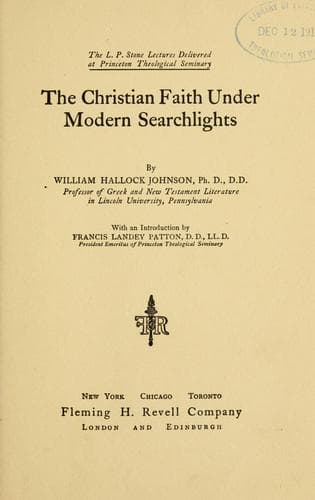
The Christian Faith Under Modern SearchlightsJohnson, William Hallock
Religion
The Christian Faith Under Modern Searchlights
Johnson, William Hallock
Modernism (Christian theology)
The external evidence for Johannine authorship is strong and, with the
exception of the obscure sect of the "Alogi,"[293] is uniform. It is
"sufficient," and there can be little doubt that it would be efficient
in producing general belief except for the theological interests
involved. Objections to the Apostolic authorship from the side of the
external evidence are based (1) upon supposed indications that John was
martyred with James at Jerusalem and never lived in Ephesus at all, and
(2) upon the statement of Papias, interpreted to mean that two men by
the name of John lived in Ephesus. (1) The evidence upon the first point
is confessedly late and confused. It is contained in the statements of
Georgios Hamartolos, a ninth-century writer, and in the so-called "De
Boor Fragment," purporting to contain an extract from a fifth-century
writer, Philip of Side. The former says that Nerva, "having recalled
John from the island, dismissed him to live in Ephesus. Then, being the
only survivor of the twelve disciples, and having composed the Gospel
according to him, he has been deemed worthy of martyrdom. For Papias,
the Bishop of Hierapolis, having been an eye-witness of him, says in the
second book of the 'Oracles of the Lord,' that he was slain by the Jews,
having, as is clear, with his brother James, fulfilled the prediction of
Christ concerning him, and his own confession and assent in regard to
this." He adds that the learned Origen, in his commentary on Matthew,
"affirms that John μεμαρτύρηκεν [memartyrêken] (has borne witness, or
suffered martyrdom), intimating that he had learned this from the
successors of the Apostles."[294] But Origen, in his comment on Matthew
xx. 23, says that "the king of the Romans, as tradition teaches,
condemned John, witnessing for the truth, to the island of Patmos." If
Georgios Hamartolos thus incorrectly refers to Origen as a witness to
the martyrdom of John, less weight attaches to his professed
reproduction of the statement of Papias.
293: Epiphanius: "Haer.," li.
294: See F. W. Worsley: "The Fourth Gospel and the Synoptists," 1909,
pp. 174 f.
Public-domain text, read in full here on John Shaqi.
Reviews
Reviews
No reviews yet
Be the first to share your thoughts on this work.
Elsewhere in the archive
Join the Discussion
Join the discussion
Sign in to leave a comment or review.
Sign InorCreate an account