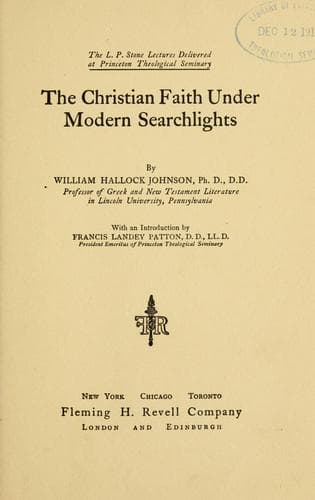
The Christian Faith Under Modern SearchlightsJohnson, William Hallock
Religion
The Christian Faith Under Modern Searchlights
Johnson, William Hallock
Modernism (Christian theology)
(2) A mediating theory, based upon the well-known statement of
Papias[297] in which a "presbyter" John may, with much probability, be
distinguished from the Apostle of that name, does not deny the influence
of the Apostle upon the construction of the Fourth Gospel, while its
ultimate authorship is assigned to the "presbyter" John. The hypothesis
of the two Johns rests upon the statement of Papias' fragment as
interpreted by Eusebius; but Eusebius, while suggesting that the
"presbyter" might have written the Apocalypse, indicates no doubt of the
Apostolic authorship of the Gospel and the First Epistle. The
possibility that there were two Johns, who were both in some sense
disciples of the Lord (as Papias describes the "presbyter"), who both
lived in Asia Minor, and who were both more or less concerned in the
writing of the Fourth Gospel, cannot be denied. But it is also possible
that Papias has been misinterpreted, and that, when he described the
"presbyter" John, the disciple of the Lord, he had only the Apostle John
in mind. In this case we should be freed from the necessity, involved in
the theory of authorship we are considering, of supposing that the
Apostle had a mysterious _alter ego_ of the same name, who was with him
alike in Palestine and in Asia Minor, shared in a degree his authority
and published the substance of his teaching, and so completely merged
his personality in that of the Apostle that in the Gospel record no
trace of a separate "presbyter" can be found, and there is no mention of
the name of either John.
297: Eusebius: "Hist. Eccl.," iii. 39. "What was said ... by John or
Matthew or any other of the Lord's disciples, and what Aristion and
the Presbyter John, the disciples of the Lord, say." The argument
for two Johns is based upon the fact that the name is mentioned
twice and that different tenses are used.
The First Epistle, supposed to be a sort of supplement to the Gospel, is
of importance in its bearing upon the question of authorship. As a
recent writer says: "The persistent note of authority which is
overheard, rather than heard, in the Epistles is the more impressive
because it is only implied. St. John assumes that his authority is
unquestioned and unquestionable by those Asians who are loyal to the
Christian tradition. When we compare his letters with those of his
younger contemporaries, we conclude that it was unquestionably because
he was an Apostle."[298]
298: Rev. H. J. Bardsley: "The Testimony of Ignatius and Polycarp to
the Authorship of 'St. John,'" _Journal of Theological Studies_,
Vol. XIV, No. 56, July, 1913, p. 491.
Public-domain text, read in full here on John Shaqi.
Reviews
Reviews
No reviews yet
Be the first to share your thoughts on this work.
Elsewhere in the archive
Join the Discussion
Join the discussion
Sign in to leave a comment or review.
Sign InorCreate an account