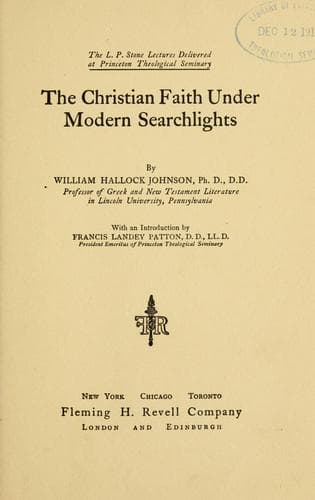
The Christian Faith Under Modern SearchlightsJohnson, William Hallock
Religion
The Christian Faith Under Modern Searchlights
Johnson, William Hallock
Modernism (Christian theology)
_Logos_, Lamb of God, propitiation for sin, are never placed by John in
the mouth of Jesus, we have strong negative evidence that the discourses
of Jesus in the Fourth Gospel are not the free composition of the author
himself.
After all, the question of the style of the Fourth Gospel is not so
important as that of its contents. Does it draw an essentially different
picture of Jesus from that of the Synoptic writers, or does it help us
to fill out and to interpret the Synoptic portrait? Two considerations
of a general nature should be kept in mind. Ordinary readers of the
Gospels in all ages have seen no lack of unity in the composite portrait
of the four Gospels; and recent criticism has shown that even to the
sharp sighted modern critic the harmony is so great that one who rejects
the historical character of John's Gospel will also reject the Second
Gospel, which was written from the standpoint that Jesus is the Son of
God (so Bousset), and is to be distinguished from the Fourth Gospel in
degree (_graduel_) rather than in essence. The aim of Mark, and there is
no reason to doubt that he reaches his aim, is in fact the same as that
of John, so far as concerns his desire that his readers may believe that
Jesus is the Christ, the Son of God (John xx. 31).
If what the Synoptic Gospels say is true as to the words and the works
and the claims and the consciousness of Jesus, then we should expect
some such supplement as we find in John. We should expect either more or
less than we find in the Synoptic Gospels. When we read of the Divine
Voice at the baptism and the transfiguration, we ask, What did Jesus
Himself conceive His relation to God to be? The full answer is in John.
When we read, "Where two or three are gathered together in my name,
there am I in the midst of them" (Matt. xviii. 20), we should expect
fuller teaching on the relation of Jesus to the disciples. This we have
in the last discourses in John. When we read in the Synoptists accounts
of the teaching and the mighty works, we turn to John for the full
description of the Teacher and Lord, and of the mighty Worker
manifesting His glory. The Synoptic Gospels tell us of the authority of
Jesus and of His office of judgment and of His founding a Church. In
John we see the ground of His authority in His relation to God and in
His mystical relation to the disciples. In the Synoptists we have the
Last Supper and general prophecies of the future and commands for the
guidance of the Church. We should expect some more intimate and personal
revelation of His relation to the disciples, such as is furnished by the
Johannine picture of the disciple whom Jesus loved, and in the words,
"Woman, behold thy son" (John xix. 26, 27); and in the intimate
discourse of John xiv.-xvi. When we read, once more, that Jesus often
retired for prayer, but in the Synoptic Gospels have the record of only
one or two of His petitions: "Remove this cup from me.... Thy will be
done" (see Luke xxii. 42 and compare xxii.
Public-domain text, read in full here on John Shaqi.
Reviews
Reviews
No reviews yet
Be the first to share your thoughts on this work.
Elsewhere in the archive
Join the Discussion
Join the discussion
Sign in to leave a comment or review.
Sign InorCreate an account