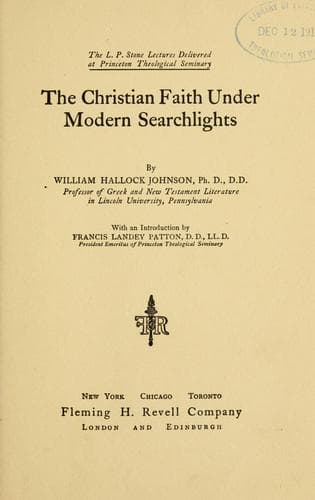
The Christian Faith Under Modern SearchlightsJohnson, William Hallock
Religion
The Christian Faith Under Modern Searchlights
Johnson, William Hallock
Modernism (Christian theology)
Relationships of a more subtle kind may be found when John is compared
with the Synoptic Gospels. (1) The relation of Jesus to His mother is
the same in both. Compare Luke ii. 49, "Knew ye not that I must be in
the things of my Father"; and John ii. 4, "Woman, what have I to do
with thee?" The relation with His brethren is also the same, their right
to influence Him not being admitted. (2) The causes of opposition are
differently described, but are the same in principle. In both Mark ii.
and John v., the charges against Him are those of blasphemy and Sabbath
breaking, and in both cases are made in connection with the miracle of
healing. His defense of His action in healing on the Sabbath day is the
same in principle but different in detail. In both there is an _à
fortiori_ argument: "How much then is a man of more value than a sheep!"
(Matt. xii. 12); "If a man receive circumcision on the Sabbath ... are
ye wroth with me because I made a man every whit whole on the Sabbath?"
(John vii. 23). In both cases His action is defended by reference to His
unique position, in the one case in His relation to God, "My Father
worketh hitherto" (John v. 17); and in the other case in His relation to
men, "The Son of man is lord even of the Sabbath" (Mark ii. 28). (3) The
relation of Jesus to various classes of people as described by John is
remarkably different in detail, but wonderfully similar in essence, when
compared with the Synoptic record. In each with entire difference of
scene and circumstance He meets with a woman that was a sinner, but the
essentials of penitence and the public expression of gratitude are
similar in both (Luke vii. 37 f.; John iv. 7 f.). No narratives could be
more independent of each other than those of the conversation with
Nicodemus in John iii., and with the rich young ruler in Mark x., yet in
both cases the attitude of Jesus towards an influential and upright and
religious man was the same. In spite of difference in language also, the
words to Nicodemus, "Ye must be born again" (John iii. 7), do not differ
in their radical demands from the words addressed to the ruler, "One
thing thou lackest: go, sell whatsoever thou hast and come, follow me"
(Mark x. 21).
The comparison might be continued indefinitely, but only to show that
the picture of Jesus and of His relation to the Father, and to His
disciples, to publicans and sinners, to the Pharisees, to women, and to
the human race as Saviour and Judge, is so different in John that it
cannot be due merely to the influence of the Synoptic tradition, and yet
so identical in substance that it cannot possibly, with any regard for
literary probabilities, have been the free invention of the writer.
Public-domain text, read in full here on John Shaqi.
Reviews
Reviews
No reviews yet
Be the first to share your thoughts on this work.
Elsewhere in the archive
Join the Discussion
Join the discussion
Sign in to leave a comment or review.
Sign InorCreate an account