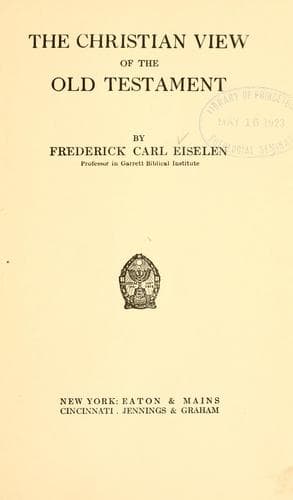
The Christian View of the Old TestamentEiselen, Frederick Carl
Religion
The Christian View of the Old Testament
Eiselen, Frederick Carl
Bible. Old Testament -- Criticism, interpretation, etc.
Equally profitable is the study of the Wisdom literature. The wise men
accepted the great religious truths proclaimed by the prophets; it was
their business to apply them to the details of everyday life, and
instruct their contemporaries in that application. They did an
important and necessary work; they pointed out constantly and
persistently that religion cannot be separated from the daily life.
But the wise men were dealing with persons who had hardly gone beyond
the childhood stage in things religious and ethical, hence they must
put the most profound truths in the simplest possible form. They must
abstain, as far as possible, from all speculation, and confine
themselves to simple, practical precepts which would appeal to the
ordinary practical common sense of the hearer. "The great desire of
the sages," says Marshall, "was to reduce the lofty theistic morality
which underlies Mosaism to brief, pithy sayings, easily remembered and
readily applicable to the everyday life of man."[18] Certainly, in
time they would be compelled to rise above simple precepts and try to
solve some of {245} the more perplexing problems of life; on the other
hand, there would always be a demand for the more simple sayings of
these moral guides. The Old Testament contains specimens of these
different productions of wisdom activity. The book of Proverbs is a
collection of the more simple, practical precepts, while the books of
Job and Ecclesiastes illustrate speculative wisdom.
The charge has sometimes been made against the book of Proverbs that it
is not truly religious, that it moves on a lower plane, and
contemplates lower aims than the other books of the Old Testament; but
this is only a half truth. That the book differs from other books is
undoubtedly true, but that is due to the purpose of its author. He did
not mean to collect prophetic discourses or sublime religious lyrics,
but those simple precepts of life which, though simple, are ever needed
for the proper conduct of man. There are two phases of religion: the
one internal, the religious experience; the other external, the
religious life. The two go together, though at times the one, at times
the other, may be emphasized. The authors of the Proverbs emphasized
chiefly the latter. They teach the most difficult of all lessons: how
to practice religion; how to fulfill the duties and overcome the
temptations of everyday life. But these wise men rested their
practical teaching upon a religious basis. Their {246} religion may
not be on a New Testament level, but in this they resemble other Old
Testament writings; their conceptions of reward and punishment may be
crude, and at times materialistic, but this peculiarity they share with
all those saints of Israel whose vision is limited to this world.
Public-domain text, read in full here on John Shaqi.
Reviews
Reviews
No reviews yet
Be the first to share your thoughts on this work.
Elsewhere in the archive
Join the Discussion
Join the discussion
Sign in to leave a comment or review.
Sign InorCreate an account