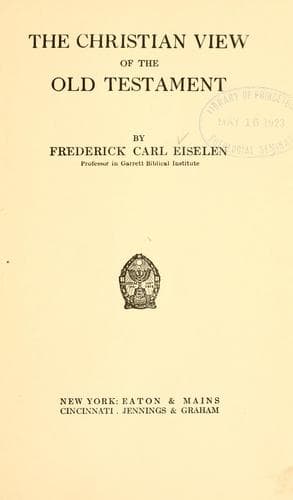
The Christian View of the Old TestamentEiselen, Frederick Carl
Religion
The Christian View of the Old Testament
Eiselen, Frederick Carl
Bible. Old Testament -- Criticism, interpretation, etc.
"But," some one will say, "if this is true how is it that criticism has
been and still is condemned unsparingly by many men whose sincerity
{101} and love for the truth cannot be called into question?" There
are several reasons for this. In the first place even some very
intelligent men seem to misunderstand both the purpose and the claims
of the higher criticism. Another reason is that there are even among
the evangelical critics those who lack judgment, and who permit
themselves to draw inferences unwarranted by the facts in the case. As
a consequence, ill-informed persons have concluded that all the results
of criticism are unwarranted by the facts. A third reason is that some
critics are arrogant and obnoxious in the presentation of their views,
and, therefore, bring the entire process into disrepute. A fourth, and
perhaps the most important, reason is that in addition to the
legitimate higher criticism discussed in the preceding pages there is
an illegitimate criticism which very frequently, though erroneously, is
thought to be the only kind of criticism practiced. This criticism
also studies the facts, but--and this is its distinguishing
feature--its investigations are colored by certain presuppositions,
such as the belief in a materialistic or deistic evolution, in the
presence of which there is no room for inspiration, or for the
supernatural, or for miracles, in the Christian sense of these terms.
This kind of criticism is not legitimate, because it is not scientific,
proceeding as it does on the basis of an unestablished, {102}
unchristian, and impossible view of the universe. But higher critics
belonging to this class are few in number, and fairness and Christian
courtesy demand that in any discussion of the subject clear
distinctions should be made between this criticism and that process of
investigation which is not only legitimate, but indispensable. It is
also well to bear in mind that the conclusions of the illegitimate
criticism will never be disproved by denunciation, but, rather, by the
careful and painstaking labors of those critics who approach their
studies without these unwarranted assumptions.
Public-domain text, read in full here on John Shaqi.
Reviews
Reviews
No reviews yet
Be the first to share your thoughts on this work.
Join the Discussion
Join the discussion
Sign in to leave a comment or review.
Sign InorCreate an account