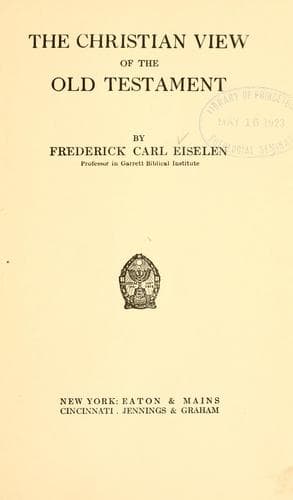
The Christian View of the Old TestamentEiselen, Frederick Carl
Religion
The Christian View of the Old Testament
Eiselen, Frederick Carl
Bible. Old Testament -- Criticism, interpretation, etc.
But not only has criticism not taken away anything essential from the
Bible; on the contrary, it has resulted in some distinct gains. The
textual criticism has furnished the modern {106} student with a much
more accurate text of the biblical books, while the linguistic
criticism has established the interpretation of this text upon a firmer
basis. The higher criticism also has made invaluable contributions
toward a more adequate understanding of the Old Testament Scriptures.
It has made impossible the arbitrary and, sometimes, unreasonable
interpretations of scripture which in former ages have proved a serious
detriment to religion and theology. It has restored to religious use
some of the biblical books almost forgotten before, and endowed them
with flesh and blood by throwing bright light upon the circumstances
connected with their origin. It has made it possible to secure a
"reasonable, probable, and even thrilling" view of the history and
religion of Israel and of the steps by which the records of these grew
up. Many of the moral, religious, and historical difficulties which
served as effective weapons to skeptics in all ages have disappeared,
and the weapons have been snatched from the enemies of the Bible. Many
of the confusions and apparent discrepancies, which according to former
theories presented insurmountable difficulties, have found a
satisfactory explanation. "Higher criticism," says R. F. Horton, "so
much dreaded by pious souls, is furnishing a conclusive answer to the
untiring opponents of revelation."[36] Everyone knows {107} that the
Bible has been bitterly attacked in the past, and that such attacks
have not altogether ceased even now; but it is sometimes overlooked
that in the majority of cases these attacks are made by men who are, or
seem to be, lamentably ignorant of the attitude and results of modern
critical study. Their arguments become "absolutely powerless against
the modern historical interpretation of the Bible; and the more that
interpretation underlies the teaching of the young, the more certain
are those attacks to die a natural death."[37]
There are, indeed, few Old Testament scholars who would not indorse the
testimony of Professor A. S. Peake, given in a paper on "Permanent
Results of Biblical Criticism," read before the Fourth Methodist
Ecumenical Conference: "Speaking for myself, I may truthfully say that
my sense of the value of Scripture, my interest in it, my attachment to
it, have been almost indefinitely enhanced by the new attitude and new
mode of study which criticism has brought to us."
NOTES ON CHAPTER III
[1] Old Testament Criticism and the Christian Church, p. 1.
[2] The Integrity of Scripture, p. 1.
[3] The History of the Higher Criticism of the New Testament, p. 85.
[4] Old Testament Criticism and the Christian Church, p. 47.
{108}
[5] General Introduction to the Old Testament: The Text, pp. 162, 163.
Public-domain text, read in full here on John Shaqi.
Reviews
Reviews
No reviews yet
Be the first to share your thoughts on this work.
Elsewhere in the archive
Join the Discussion
Join the discussion
Sign in to leave a comment or review.
Sign InorCreate an account