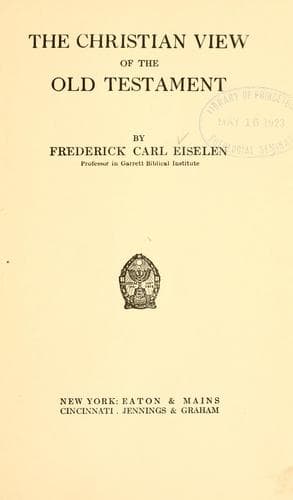
The Christian View of the Old TestamentEiselen, Frederick Carl
Religion
The Christian View of the Old Testament
Eiselen, Frederick Carl
Bible. Old Testament -- Criticism, interpretation, etc.
[21] A. T. Clay, Light on the Old Testament from Babel, p. 143.
[22] S. R. Driver, The Book of Genesis, p. liii, quoted in part from G.
A. Smith, Modern Criticism and the Preaching of the Old Testament, p.
101.
{160}
CHAPTER V
THE OLD TESTAMENT AND COMPARATIVE RELIGION
The present is an era of comparative study. We no longer study
subjects by themselves, but compare them with correlated experiences
and phenomena. "In the sphere of language study we have the science of
comparative philology. Language is compared with language. By means
of this comparison we have found that there are groups of languages
closely related to one another; and, comparing these groups with one
another, we have discovered certain universal laws of language.
Comparing further the languages within each group, we ascertain the
laws common to that group. By such comparison a flood of light has
been thrown on language. We know Greek and Latin and Hebrew to-day as
our predecessors did not know them."[1] The same principle of
comparison is now applied to the study of history, of literature, of
philosophy, of ethics, and of religion, including the literature and
religion of the Hebrews. Men are laying to-day the entire Hebrew
literature, history, and religion alongside of the literatures,
histories, and religions of other {161} nations, testing them by the
same methods and applying to them the same rules.
What should be the attitude of the Christian toward this method of
study? When the science of comparative philology first asserted itself
many good Christians set themselves against it, because one of its
claims was that Hebrew is not the original language given by God to
men. Comparative philology has won its way, and Bible students are
truly grateful for the light it has shed upon sacred scripture. When
the comparative study of the Scriptures was first advocated there were
many timid souls who felt that this method of study was an attack upon
the Bible, which could only issue in such an overturning of belief that
the Church would remain helpless with a worthless Bible. Hence they
set themselves with all their might against the new study as an enemy
of Christianity. Is this the proper attitude? In the first place, it
is well to remember that the Bible has withstood all attacks for
thousands of years. Its great river of truth has flowed serenely on,
watering the whole earth with its life-giving streams, and refusing to
be dammed up by any foe. Surely, history teaches that there need be no
fear that any new method of study will bring about an end of the
Bible's reign. On the other hand, history teaches the folly of
resisting the progress of science along any line of investigation.
{162} True science will win its way just as surely as the teaching of
the Bible will win its way into the hearts of men. Hence it would seem
the part of wisdom to encourage rather than to discourage the efforts
of the comparative student of the Old Testament.
Public-domain text, read in full here on John Shaqi.
Reviews
Reviews
No reviews yet
Be the first to share your thoughts on this work.
Elsewhere in the archive
Join the Discussion
Join the discussion
Sign in to leave a comment or review.
Sign InorCreate an account