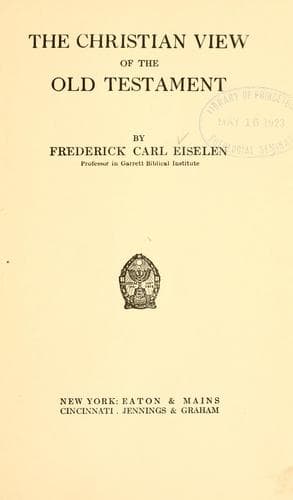
The Christian View of the Old TestamentEiselen, Frederick Carl
Religion
The Christian View of the Old Testament
Eiselen, Frederick Carl
Bible. Old Testament -- Criticism, interpretation, etc.
For there is hope of a tree,
If it be cut down, that it will sprout again,
And that the tender branch thereof will not cease.
Though the root thereof wax old in the earth,
And the stock thereof die in the ground;
Yet through the scent of water it will bud,
And put forth boughs like a plant.
But man dieth, and is laid low;
Yea, man giveth up the ghost, and where is he?
As the waters fail from the sea,
And the river wasteth and drieth up;
So man lieth down and riseth not:
Till the heavens be no more, they shall not awake,
Nor be roused out of their sleep.
{185} These are expressions of deepest despondency and despair over a
life soon ended, never to be lived again here upon earth.
However, by far the greatest number of Old Testament passages dealing
with the subject express a belief in a continuous existence after death
in Sheol. Sheol is the place of departed personalities; the
generations of one's forefathers are there: he who dies is gathered
unto his fathers; the tribal divisions of one's race are there: the
dead is gathered unto his people; and if his descendants have died
before him, they are there, and he goes down to them, as Jacob to his
son (Gen. 37. 35: "For I will go down to Sheol to my son mourning"),
and David to his child (2 Sam. 12. 23: "I shall go to him, and he shall
not return to me").
There are only a few passages which go beyond this, expressing a hope
of immortality or a resurrection. There is, for example, the hope
expressed in Psa. 16. 8-11:
I have set Jehovah always before me:
Because he is at my right hand, I shall not be moved.
Therefore my heart is glad, and my glory rejoiceth:
My flesh also shall dwell in safety.
For thou will not leave my soul to Sheol;
Neither wilt thou suffer thy holy one to see corruption.
Thou wilt show me the path of life:
In thy presence is fullness of joy;
In thy right hand there are pleasures for evermore.
The hope expressed here is not a hope of a resurrection, but, rather, a
hope that the psalmist will {186} be delivered from death and live in
fellowship with God forevermore. There are other passages which
recognize the impossibility of escaping death, but express a hope that
there will be a resurrection from death. The most definite Old
Testament teaching of a resurrection is in Dan. 12. 2, "And many of
them that sleep in the dust of the earth shall awake, some to
everlasting life, and some to shame and everlasting contempt."
These lofty hopes are peculiar to Israel. But Israel's conception of
Sheol shows very striking resemblances with the Babylonian conception.
The descriptions found in Job, in the Psalms, in Isaiah, in Ezekiel and
elsewhere, are hardly to be distinguished from those found in
Babylonian literature. The opening lines of Ishtar's descent into
Sheol read:
Public-domain text, read in full here on John Shaqi.
Reviews
Reviews
No reviews yet
Be the first to share your thoughts on this work.
Elsewhere in the archive
Join the Discussion
Join the discussion
Sign in to leave a comment or review.
Sign InorCreate an account