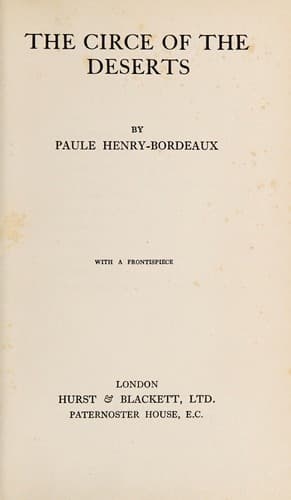
Middle East -- Description and travel; Stanhope, Hester, Lady, 1776-1839
Not being able to find in Egypt the facilities he desired to embark for
India, he proceeded to Syria, with the intention of joining the caravan
which left Damascus for Bassora. But he fell dangerously ill at Acre.
His intellectual faculties, affected by so many extraordinary events,
broke down in an alarming fashion. He was seized by a religious
exaltation and by an unfortunate devotion, for he distributed to his
neighbours the money which remained to him. And Loustaunau lived on alms
in a miserable hut in the orchards of Acre. "The Lion of the State and
the Tiger in war" wandered miserably across the country. Having
retained, the recollection of the brilliant part which prophecies had
played in his splendid past, he was seized with a passion for the Bible,
and made it his study to find a link between present events and ancient
narrations. People called him "the prophet" and respected his
inoffensive folly.
On learning of the arrival of Lady Hester, he had hastened to her, armed
with a thousand sacred texts announcing her coming. He imagined,
besides, that she was on pilgrimage to Jerusalem, but he was not
embarrassed to give another direction to his prophecies. Lady Hester
received him very cordially, divining immediately what marvellous
advantage she might derive, not from his flashes of lucidity which
revealed the keen good sense of the peasant, lofty sentiments and an
astonishing memory, but from his Biblical extravagances. In consequence,
she bestowed upon him alms in abundance. Mentally, she already relegated
Pierre to the rank of minor prophet.
Loustaunau withdrew soon in torrents of rain. The tents were overturned
like umbrellas, and Lady Hester had two narrow escapes of being buried
under her own. But it was said that that evening the doctor did not have
a moment's respite and that the march past of frightened people did not
cease. Towards midnight they came to inform him that a Frank had arrived
from Acre. He hastened into the dining-tent and found a young Dalmatian
who was about to put on the uniform of an officer of the British Navy.
Signor Thomaso Coschich--he bore this sonorous name--explained with much
importance and volubility that he had been dragoman to the Princess of
Wales during her journey from Palermo to Constantinople; that he had
crossed the Mediterranean, in the midst of war, on a walnut-shell, so
well that the fishermen of Cyprus had not recovered from their
astonishment, and that he had come to find Lady Hester to take her back
to England.
Public-domain text, read in full here on John Shaqi.
Reviews
Reviews
No reviews yet
Be the first to share your thoughts on this work.
Elsewhere in the archive
Join the Discussion
Join the discussion
Sign in to leave a comment or review.
Sign InorCreate an account