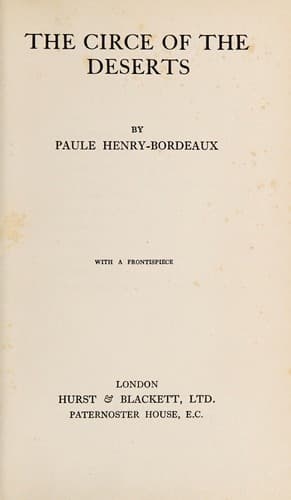
Middle East -- Description and travel; Stanhope, Hester, Lady, 1776-1839
Sometimes, she dreamed of forming an association of men of letters,
artists and savants which she would invite to travel all over the Orient
under her auspices. She aimed at founding an Institute, on the model of
that which Bonaparte had carried away to Egypt, and of which she would
naturally be the head. Leaving the women to groan and sigh at the doors
of the Academies, she was leaping the barrier of ancient customs and
traditional manners and creating on her own level. Sometimes, she
discussed the expediency of a journey in Abyssinia. Sometimes, she drew
up memoirs on the marvellous properties of bezoar in the cases of the
plague and mania. From time to time, she cast a glance towards that
Europe from which she had fled without regrets. Sharply, she judged her
fellow-countrymen, stigmatised emphatically the English statesmen as
"senseless boobies whom their ignorance and their duplicity have
exposed, not only to the laughter, but to the maledictions of
generations present and to come," traced of the Restoration a picture
engraved by a master hand and denounced the English policy against
France, a policy of which she unmasked the faults with a singular
perspicacity and an impartial violence.
"Cease to trouble yourself in regard to me," she was to write on April
22, 1816, to the Marquis of Buckingham. "I shall never return to Europe,
even if I were reduced to beg my bread here. Once only I shall go to
France to see you, James and you; but I shall go to Provence, not to
Paris, for the sight of our odious Ministers running about everywhere to
do evil, would make my gorge rise too much. I shall not be martyr for
nothing. The granddaughter of Lord Chatham, the niece of the illustrious
Pitt, _feels herself blush at being English_. What disgrace to be born
in that country which has made of its cursed gold the counterpoise of
justice, which has placed humanity in fetters--that country which has
employed valiant troops, intended to defend its national honour, as an
instrument of vengeance to oppress a free people, which has exposed to
ridicule and humiliation a monarch who might have gained the hearts of
his subjects, if the English intriguers had left him alone to reign or
abdicate.
Public-domain text, read in full here on John Shaqi.
Reviews
Reviews
No reviews yet
Be the first to share your thoughts on this work.
Elsewhere in the archive
Join the Discussion
Join the discussion
Sign in to leave a comment or review.
Sign InorCreate an account