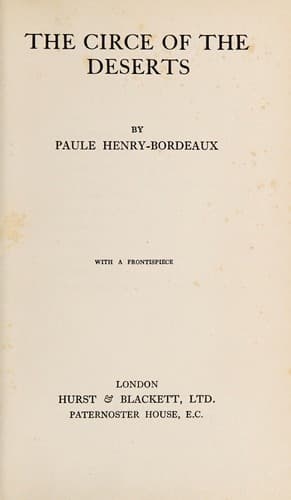
Middle East -- Description and travel; Stanhope, Hester, Lady, 1776-1839
LADY HESTER, whose health was detestable, hoped that a new sky and a new
climate would bring her that cure which always persisted in fleeing
before her. On May 10, 1813, she left the enchantress Hama without
regrets. The sun was scorching and the marching hours very trying, but
Lady Hester, who never permitted herself to be inconvenienced, slept
late and preferred to allow the porters to sweat blood and water at high
noon. The caravan went back towards the north, so far as Latakia, where
the traveller calculated to embark for Russia and perhaps for the
Indies. Meantime, she maintained an active correspondence with Ebir
Sihoud, the King of the Wahabis, her credulous imagination being
stimulated by the Bedouin stories about this prince, who had presented
himself with 800 wives. The doctor did not succeed in ascertaining what
were her intentions, until she was about to depart. "It is to be hoped
that she has no idea of making an excursion to Derazeh," said he in
alarm; "she would be capable of taking me!"
The route, meadows spotted with mauve flowers in which the horses sank,
followed the Orontes, dominated by the Ansaries mountains, a rugged
chain still covered by a coating of snow.
Only, there arrived a thing which was not expected; the plague made its
appearance and reigned as a harsh mistress over the Syrian coast.
European vessels fled from the contaminated ports. Lady Hester
accordingly hired a house and waited, without impatience, for the
country was beautiful. All the summer she hunted the hares, the
partridges, the francolins and the gazelles which abounded in the woods
of olive and sycamore-trees on the bank of the Nahr-el-Kebir. Mr.
Barker, the consul at Aleppo, had brought his little family.
On October 7, Bruce, recalled suddenly to England, set out for Aleppo
with Beaudin. He was leaving his friend for a long time. What happened
at this departure, which was to be without return? And, first, what was
he in regard to Lady Hester. Simple travelling companion or lover? The
doctor observes on this subject a discretion wholly professional. He
remarks that Bruce, during the three years in which he travelled over
the East with her, derived much from the fruit of her experience of the
world and her conversation. We know nothing in reality. But who knows if
Bruce did not think of Lady Hester what Heinrich Heine was to say later
of Marie Kalergis: "She is not a woman; she is a monument; she is the
cathedral of the god Love." And men do not much care about falling at
the feet of cathedrals; they fear the gossip of the idlers, and they
have too much difficulty in getting up again afterwards.
Public-domain text, read in full here on John Shaqi.
Reviews
Reviews
No reviews yet
Be the first to share your thoughts on this work.
Elsewhere in the archive
Join the Discussion
Join the discussion
Sign in to leave a comment or review.
Sign InorCreate an account