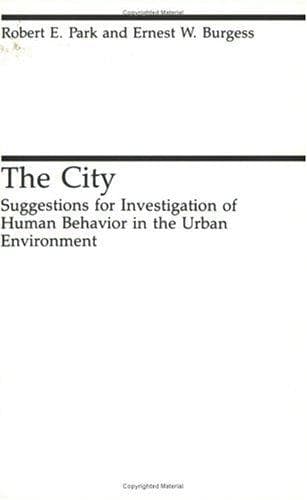
Cities and towns; Social psychology; Sociology; Sociology, Urban
City, the: A product of nature, 1–2;
an ecological unit, 2;
natural habitat of civilized man, 2;
population of, 5, 6, 8;
and human nature, 4, 46, 63;
and the division of labor, 14;
and primary relations, 23;
vice and crime in, 25;
and secondary relations, 26;
and intellectual life, 30;
crusades in, 33;
and politics, 34;
advertising in, 37;
a melting-pot, 40;
rewards eccentricity, 41;
growth of, 47;
population groups, 47;
expansion of, 49;
age groups in, 47;
aggregation, 48;
defined, 165, 169;
statistics of, 167;
and economic development, 168;
natural history of, 170;
bibliographies of, 174;
types of, 175;
relation to town and metropolis, 180;
and ecological organization, 187, 196;
as a physical mechanism, 195;
and politics, 201;
growth of population in, 208–9, 212;
as a parasitic growth, 222
City-building, 206
City life: biological aspects of, 214;
and the new moral order, 223
City man, the, life-organization of, 225
City mentality, 219
Colonies: immigrant, 26;
and second generation, 28
Communication: mechanism of, 29, 197;
and the newspaper, 39;
and social contagion, 45
Community: defined, 64, 115, 144;
and human nature, 65;
four types of, 66;
agricultural, 68;
skeletal structure of, 73;
and moral codes, 105–6;
and the delinquent, 111;
local, 114, 191;
measure of efficiency, 118;
institutions of, 199
Community-center associations, 117
Community organizations, 114
Competition, and the struggle for space, 63, 64, 71
Conurbation, 49
Crisis: financial, 21;
defined, 27;
positive law, 28
Cultural areas. _See_ Bohemia, Ghetto, Gold Coast
Culture, city-born, 2;
urban life and, 3;
and political organization, 116–17;
and the local community, 145–46
Dance hall, public, and the neighborhood, 151
Delinquency triangle, the, 152
Department store, characteristic city institution, 202
Division of labor, the, and new modes of thought, 217
Ecological organization, of the city, 2, 115
Ecology: human, 2, 63, 145;
succession, 50, 75;
centralization, 51;
climax, 68, 77;
culmination, 71;
invasion, 72, 74, 76
Economic organization, 116
Family, modern, as an environment for children, 104
Gangs, boys’, 113
Geography, urban, 165
Ghetto, 150
Group, primary: defined, 23;
primitive society, 36;
politics, 37
Hobo, the mind of, 158, 160;
colleges, 159
Hobohemia: the home of homeless men, 54;
as a cultural unit, 150
Human nature: man, a “city-building animal,” 2;
and city life, 40, 217
Industry, and community growth, 70
I.W.W.: and casual labor, 159;
songs of, 160
Juvenile delinquency, 110
Land values: and community organizations, 149;
and local segregation, 203
Literacy, and city life, 139
Local community, 114.
_See_ Community
Public-domain text, read in full here on John Shaqi.
Reviews
Reviews
No reviews yet
Be the first to share your thoughts on this work.
Elsewhere in the archive
Join the Discussion
Join the discussion
Sign in to leave a comment or review.
Sign InorCreate an account