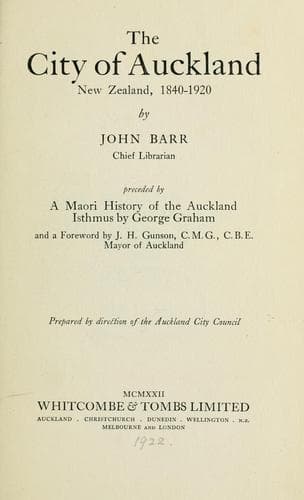
The City of Auckland, New Zealand, 1840-1920Barr, John
History
The City of Auckland, New Zealand, 1840-1920
Barr, John
Auckland (N.Z.) -- History
After the closing of the classes at the Mechanics' Institute, technical
education in Auckland seems to have fallen into neglect until 1896,
when the Auckland Technical School was founded, and carried on its
work in Rutland Street. In 1900 "The Manual and Technical Instruction
Act" was passed, and the following year the Education Board took over
the control of the school, and appointed Mr. G. George director. So
rapidly did the school develop that a new building became essential,
and the promise of a contribution of £10,000 towards its erection
having been made by the Auckland Savings Bank in 1905, steps were taken
to carry out the proposal. On August 17th, 1909, the foundation stone
of the present college was laid by the Governor, Lord Plunket, and the
building was opened in 1913 by Sir James Allen, Minister for Education
and Defence. Mr. John Mitchell was the architect, and Mr. Stanley
Jeffreys the builder; but, owing to the lack of funds, the building
as planned was not finished. Additions to meet requirements are now in
course of erection. The progress of the college may be estimated by the
figures of attendance. In 1902 the number of pupils was thirty. At the
opening of the new school (1913) there were 1627 individual students in
attendance at day or night classes.
In 1872 Sir George Maurice O'Rorke, whose whole life was associated
with the Auckland University College, and who was Chairman of the
Council from its inception until his death on 24th August, 1916,
made an unsuccessful effort to institute a university in the city.
Five years later another agitation was set in being, and resulted in
the appointment of a Royal Commission on University and Secondary
Education, which reported in July, 1879. Its recommendations were
embodied in the "Auckland University College Act, 1882." The Bill was
introduced by Mr. J. A. Tole in 1881, when it was shelved, but received
legislative sanction in the following year. To accelerate the opening
of the college, the Premier sent instructions to the Agent-General
in London to appoint professors, and upon the arrival of the staff
the college was opened by the Governor, Sir William F. D. Jervois, on
May 21st, 1883, in the buildings in Eden Street, formerly used as a
District Court House, and the old Admiralty House, Short Street.
Public-domain text, read in full here on John Shaqi.
Reviews
Reviews
No reviews yet
Be the first to share your thoughts on this work.
Elsewhere in the archive
Join the Discussion
Join the discussion
Sign in to leave a comment or review.
Sign InorCreate an account