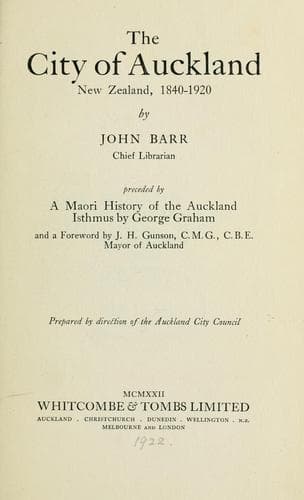
The City of Auckland, New Zealand, 1840-1920Barr, John
History
The City of Auckland, New Zealand, 1840-1920
Barr, John
Auckland (N.Z.) -- History
Another Huddart-Parker liner, the _Wimmera_ (3021 tons), was sunk on
June 26th, 1918, off North Cape, after striking a submerged mine. At
the time of the disaster she was on a voyage from Auckland to Sydney.
After the explosion the life-boats were lowered, and five of them got
safely away. One of the boats (No. 4) was stoved in against the ship,
and most of its complement perished. Altogether, ten passengers and
sixteen of the crew, including Captain R. J. Kell, were drowned.
The city's municipal progress in the last twenty years has been most
marked. The Corporation's motto, "Advance," appears to have been kept
in mind and lived up to, and in no direction was this activity more
noticeable than in the city's streets. In 1902 Auckland possessed
only one paved street; there are now thirty-three streets laid in
either asphalt, wood blocks, or concrete, as well as a large number
of macadamised roads. The failure of a supply of good road metal
retarded Auckland's progress in road making, but the substitution
of concrete has had successful results, and the Council has given
authority for a large number of streets to be laid in this material,
and the work is now being proceeded with. Another project which has
engaged the attention of the Corporation was the widening of narrow
streets, in order to carry the increased traffic which now passes over
them. The improvements are most apparent on the waterfront, where the
co-operation of the Harbour Board was obtained, and the largest and
most costly undertaking of this class of work was the scheme known
as the eastern outlet. This work necessitated the purchase of all
properties between Beach Road and Jermyn Street, the widening of the
first named from 66 feet to 110 feet, and the laying down of a new
thoroughfare, named Anzac Avenue, 84 feet wide, from Beach Road to
Lower Symonds Street. The making of this new highway was commenced in
1915, and the trams commenced running on it in February, 1921.
[Illustration: Auckland, from the North Shore]
[Illustration: Auckland from the Ferry Buildings looking Eastward
Showing the wharves, Quay Street and Kings Drive (recently reclaimed).
Devonport and Rangitoto on the left]
The opening, in 1910, of the Grafton Bridge, which is constructed in
ferro-concrete, and is notable as having the longest three-hinged arch
in the world, was another important undertaking, which provided
easy access to the Hospital and Domain, and linked up Parnell and
Newmarket with the western districts of the city.
Public-domain text, read in full here on John Shaqi.
Reviews
Reviews
No reviews yet
Be the first to share your thoughts on this work.
Elsewhere in the archive
Join the Discussion
Join the discussion
Sign in to leave a comment or review.
Sign InorCreate an account