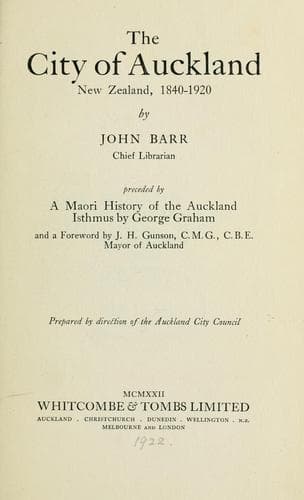
The City of Auckland, New Zealand, 1840-1920Barr, John
History
The City of Auckland, New Zealand, 1840-1920
Barr, John
Auckland (N.Z.) -- History
The erection of the Town Hall, which commenced in 1908, was significant
of the position which the municipality had now attained. The question
of a Town Hall had been under consideration from 1880, but until this
time the Council had not been in a position to do anything. Prior
to the opening of the Town Hall, the Council's staff had no settled
headquarters, the first Council offices under the present constitution
being located in rooms over Messrs. Upton and Co.'s book shop, Queen
Street. As the Council's affairs increased, further accommodation was
found necessary, and the old Magistrate's Court, at the corner of High
and Chancery Streets, was obtained to meet the requirements. After the
opening of the Public Library and Art Gallery, the Council utilised
some of the rooms in this building as municipal chambers, and here
the Council's work was carried on until the Town Hall was ready for
occupation.
The foundation stone of the Town Hall was laid by the Mayor, Mr. A.
M. Myers, on the 24th February, 1909, and the building was opened by
the Governor, Baron Islington, on the 14th December, 1911, Mr. C. J.
Parr, Mayor, presiding at the ceremony which took place in the large
hall. The festivities connected with the opening continued for a week,
concerts, organ recitals, oratorios, and the annual reunion of the
Old Colonists' Association being held in the new hall. The building
was designed by Messrs. J. J. and E. J. Clark, of Melbourne, and the
contractors were Messrs. Ferguson and Malcolm, of Auckland, whose
contract for the work was £87,565.
The building is divided into two portions, one being devoted to
administrative purposes, including the Council Chamber, and the other
comprising the halls, of which there are two, with a supper room and
ante-rooms. The large hall has seating accommodation for 2700, and the
orchestral platform and chorus galleries can seat 350 performers. The
Concert Chamber has seating capacity for 880 persons.
At the opening ceremony the Mayor formally acknowledged two splendid
gifts, which had been made to the citizens and erected in the Town
Hall. These were the pipe organ, the gift of Mr. Henry Brett, and the
clock, which was presented by Mr. A. M. Myers.
The finances of the city show clearly the present position of municipal
affairs, and the development which has been made in the last two
decades. The city's annual valuation in 1901 was £349,765; to-day
it stands at £1,497,095. The Council's revenue at the same date was
£1,077,047, compared with £82,657 twenty years ago.
The spirit of civic progress was not confined to the municipal
authority for the Harbour Board also embarked upon a huge programme of
work, which is still going on, and which has completely transformed the
waterfront, making it one of the most up-to-date ports in Australasia.
It even permeated to individuals, as the record of benefactions amply
demonstrates. Some of these benefactions have already been mentioned,
but others remain to be described.
Public-domain text, read in full here on John Shaqi.
Reviews
Reviews
No reviews yet
Be the first to share your thoughts on this work.
Elsewhere in the archive
Join the Discussion
Join the discussion
Sign in to leave a comment or review.
Sign InorCreate an account