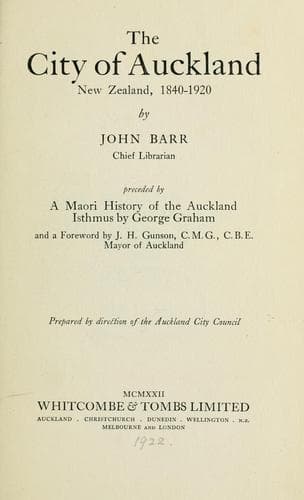
The City of Auckland, New Zealand, 1840-1920Barr, John
History
The City of Auckland, New Zealand, 1840-1920
Barr, John
Auckland (N.Z.) -- History
The Auckland Patriotic League, which afterwards became the Auckland
Provincial Patriotic and War Relief Association, was formed in the
first month of the war, the Mayor of Auckland being chairman _ex
officio_. Mr. C. J. Parr was the first chairman, occupying the position
from August, 1914, to April, 1915, when he was succeeded by Mr. J. H.
Gunson, who has held the position up to the present. In recognition of
his services to this and other patriotic endeavours, including the
work which he did on the National Efficiency Board[29] he was made an
officer of the Order of the British Empire (O.B.E.) in 1918, and in the
following year was elevated to the commandership of the Order (C.B.E.).
The Mayoress (Mrs. Gunson) was also made an officer of the same Order,
in acknowledgement of her patriotic work.
The total funds collected by the Patriotic and War Relief Association
from the 10th August, 1914, until the end of September, 1921, including
interest, amounted to over half a million sterling.
The official peace celebrations were held on July 19th, 1919. A
universal holiday was observed, and the city wore a gala appearance,
bunting and decorations being everywhere in evidence. The official part
of the proceedings commenced with a procession, which formed at the
foot of Queen Street, and travelled to the Domain. In the procession
the men who had served in the war took pride of place. The official,
consular and civil life of the city was also represented. Next to the
soldiers, in point of interest, were the various local organisations
which had taken part in the work connected with the war and patriotic
endeavour. Many of these associations were represented by members
who wore symbolic costumes and were conveyed in tastefully decorated
vehicles, adding a picturesque touch to the procession.
At the Domain the troops, of which some 5500 were on parade, marched
past the saluting base, Colonel H. R. Potter, C.M.G., officer
commanding the district, taking the salute. At the conclusion of the
military function the Deputy-Mayor (Mr. A. J. Entrican) read the
King's message, after which a salute of twenty-one guns was fired.
The returned soldiers were then entertained to lunch by the Peace
Celebrations Committee.
At night the city was transformed into a carnival. Bonfires were lit,
and the spirit of revelry was abroad, but owing to the coal shortage
only limited illuminations were permitted.
Public-domain text, read in full here on John Shaqi.
Reviews
Reviews
No reviews yet
Be the first to share your thoughts on this work.
Elsewhere in the archive
Join the Discussion
Join the discussion
Sign in to leave a comment or review.
Sign InorCreate an account