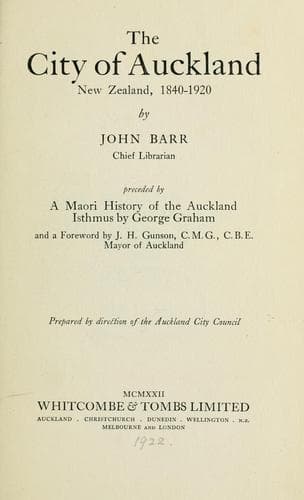
The City of Auckland, New Zealand, 1840-1920Barr, John
History
The City of Auckland, New Zealand, 1840-1920
Barr, John
Auckland (N.Z.) -- History
The Soldiers' Club was opened on September 13th, 1915, in rooms of the
Y.M.C.A., which were loaned by the directors. As larger numbers of
repatriated soldiers came back to Auckland, the accommodation at the
Y.M.C.A. became insufficient, and new premises for the club were found
in Albert Street, which were opened on 20th October, 1920.
The most serious epidemic of disease ever experienced in Auckland
was the outbreak of influenza, which occurred in October, 1918.
The account of the epidemic given in the "Auckland and Charitable
Aid Board: a History" is the best account the writer has seen, and
he therefore makes no apology for quoting from it. "Influenza in a
somewhat unusual form was prevalent in the city from the early part
of October ... but the worst phases dated from a fortnight after the
arrival of the R.M.S. _Niagara_ from Vancouver, on the 12th of the
month.... On the berthing of the vessel in Auckland, twenty-eight men
were removed to the Hospital and placed in an isolation ward. Within
a few days the disease was communicated to members of the Hospital
staff. Simultaneously it spread to the community.... The insufficiency
of the ordinary hospital accommodation to meet the demands of such
an extraordinary emergency were early apparent. Temporary hospitals
were accordingly established at the Seddon Memorial Technical College,
"Kilbryde" (Point Resolution), the Sailors' Home, the Avondale
racecourse buildings, Myers Kindergarten, the Y.W.C.A. hostel, Vermont
Street schools, and St. Joseph's schoolroom, Grey Lynn. The Auckland
Racing Club's buildings at Ellerslie were converted into a temporary
convalescent home.... Rigorous measures were taken at the beginning of
November to limit the spread of the disease. Business in the city was
brought almost to a standstill. Places of amusement and worship, banks,
schools, hotel bars, and many warehouses were closed; public meetings
... were forbidden; such facilities as the telegraphic, telephonic,
railway and shipping services were curtailed, and all classes of
the community united in the supreme work of meeting [combating] the
scourge.... The visitation was at its height in the first two weeks of
November.... By the middle of November it was evident that the progress
of the disease had been stayed, and from that time onward it gradually
diminished in severity until by the end of the month only isolated
cases remained."
The official statistics of the deaths for the Auckland registration
district during the period of the epidemic was 1013, or 7.57 per
thousand of the population. The largest number of deaths recorded in
one day was 56.
On November 8th an announcement of the signing of the Armistice was
received in Auckland, which later proved to have been premature.
Despite the epidemic, which was then at its height, the city went wild
with joy, and never were such scenes enacted as on that morning. When
the official intimation was received, four days later, there was no
demonstration.
Public-domain text, read in full here on John Shaqi.
Reviews
Reviews
No reviews yet
Be the first to share your thoughts on this work.
Elsewhere in the archive
Join the Discussion
Join the discussion
Sign in to leave a comment or review.
Sign InorCreate an account