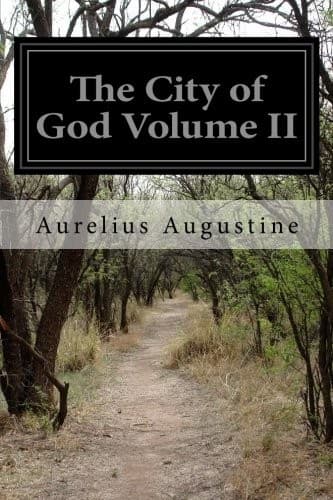
The City of God, Volume IIAugustine, of Hippo, Saint
ReligionChristian
The City of God, Volume II
Augustine, of Hippo, Saint
Apologetics -- Early works to 1800; Kingdom of God -- Early works to 1800
We might have supposed that the words uttered at the creation of man,
"Let us," and not Let me, "make man," were addressed to the angels,
had He not added "in our image;" but as we cannot believe that man
was made in the image of angels, or that the image of God is the
same as that of angels, it is proper to refer this expression to the
plurality of the Trinity. And yet this Trinity, being one God, even
after saying "Let _us_ make," goes on to say, "And God made man in
His image,"[241] and not "Gods made," or "in their image." And were
there any difficulty in applying to the angels the words, "Come,
and let us go down and confound their speech," we might refer the
plural to the Trinity, as if the Father were addressing the Son and
the Holy Spirit; but it rather belongs to the angels to approach God
by holy movements, that is, by pious thoughts, and thereby to avail
themselves of the unchangeable truth which rules in the court of
heaven as their eternal law. For they are not themselves the truth;
but partaking in the creative truth, they are moved towards it as
the fountain of life, that what they have not in themselves they may
obtain in it. And this movement of theirs is steady, for they never
go back from what they have reached. And to these angels God does not
speak, as we speak to one another, or to God, or to angels, or as the
angels speak to us, or as God speaks to us through them: He speaks
to them in an ineffable manner of His own, and that which He says is
conveyed to us in a manner suited to our capacity. For the speaking
of God antecedent and superior to all His works, is the immutable
reason of His work: it has no noisy and passing sound, but an energy
eternally abiding and producing results in time. Thus He speaks to
the holy angels; but to us, who are far off, He speaks otherwise.
When, however, we hear with the inner ear some part of the speech
of God, we approximate to the angels. But in this work I need not
labour to give an account of the ways in which God speaks. For either
the unchangeable Truth speaks directly to the mind of the rational
creature in some indescribable way, or speaks through the changeable
creature, either presenting spiritual images to our spirit, or bodily
voices to our bodily sense.
The words, "Nothing will be restrained from them which they have
imagined to do,"[242] are assuredly not meant as an affirmation, but
as an interrogation, such as is used by persons threatening, as,
_e.g._, when Dido exclaims,
"They will not take arms and pursue?"[243]
Public-domain text, read in full here on John Shaqi.
Reviews
Reviews
No reviews yet
Be the first to share your thoughts on this work.
Elsewhere in the archive
Join the Discussion
Join the discussion
Sign in to leave a comment or review.
Sign InorCreate an account