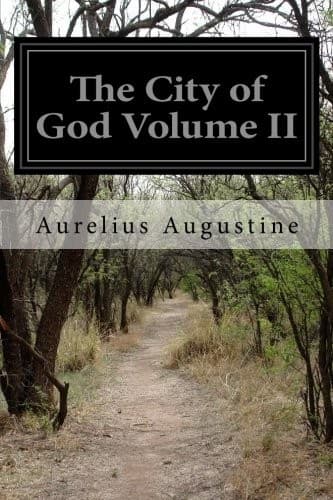
The City of God, Volume IIAugustine, of Hippo, Saint
ReligionChristian
The City of God, Volume II
Augustine, of Hippo, Saint
Apologetics -- Early works to 1800; Kingdom of God -- Early works to 1800
Therefore prophetic utterances of three kinds are to be found;
forasmuch as there are some relating to the earthly Jerusalem, some
to the heavenly, and some to both. I think it proper to prove what I
say by examples. The prophet Nathan was sent to convict king David
of heinous sin, and predict to him what future evils should be
consequent on it. Who can question that this and the like pertain
to the terrestrial city, whether publicly, that is, for the safety
or help of the people, or privately, when there are given forth for
each one's private good divine utterances whereby something of the
future may be known for the use of temporal life? But where we read,
"Behold, the days come, saith the Lord, that I will make for the
house of Israel, and for the house of Judah, a new testament: not
according to the testament that I settled for their fathers in the
day when I laid hold of their hand to lead them out of the land of
Egypt; because they continued not in my testament, and I regarded
them not, saith the Lord. For this is the testament that I will make
for the house of Israel: after those days, saith the Lord, I will
give my laws in their mind, and will write them upon their hearts,
and I will see to them; and I will be to them a God, and they shall
be to me a people;"[347]--without doubt this is prophesied to the
Jerusalem above, whose reward is God Himself, and whose chief and
entire good it is to have Him, and to be His. But this pertains
to both, that the city of God is called Jerusalem, and that it is
prophesied the house of God shall be in it; and this prophecy seems
to be fulfilled when king Solomon builds that most noble temple.
For these things both happened in the earthly Jerusalem, as history
shows, and were types of the heavenly Jerusalem. And this kind of
prophecy, as it were compacted and commingled of both the others in
the ancient canonical books, containing historical narratives, is
of very great significance, and has exercised and exercises greatly
the wits of those who search holy writ. For example, what we read
of historically as predicted and fulfilled in the seed of Abraham
according to the flesh, we must also inquire the allegorical meaning
of, as it is to be fulfilled in the seed of Abraham according to
faith. And so much is this the case, that some have thought there
is nothing in these books either foretold and effected, or effected
although not foretold, that does not insinuate something else which
is to be referred by figurative signification to the city of God
on high, and to her children who are pilgrims in this life. But
if this be so, then the utterances of the prophets, or rather the
whole of those Scriptures that are reckoned under the title of the
Old Testament, will be not of three, but of two different kinds.
For there will be nothing there which pertains to the terrestrial
Jerusalem only, if whatever is there said and fulfilled of or
concerning her signifies something which also refers by allegorical
Public-domain text, read in full here on John Shaqi.
Reviews
Reviews
No reviews yet
Be the first to share your thoughts on this work.
Elsewhere in the archive
Join the Discussion
Join the discussion
Sign in to leave a comment or review.
Sign InorCreate an account