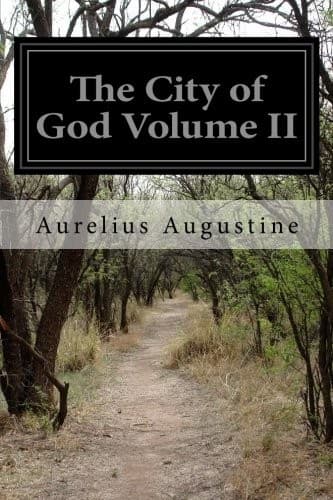
The City of God, Volume IIAugustine, of Hippo, Saint
ReligionChristian
The City of God, Volume II
Augustine, of Hippo, Saint
Apologetics -- Early works to 1800; Kingdom of God -- Early works to 1800
Yet no one ought to suppose either that these things were written for
no purpose, or that we should study only the historical truth, apart
from any allegorical meanings; or, on the contrary, that they are
only allegories, and that there were no such facts at all, or that,
whether it be so or no, there is here no prophecy of the church.
For what right-minded man will contend that books so religiously
preserved during thousands of years, and transmitted by so orderly
a succession, were written without an object, or that only the bare
historical facts are to be considered when we read them? For, not
to mention other instances, if the number of the animals entailed
the construction of an ark of great size, where was the necessity of
sending into it two unclean and seven clean animals of each species,
when both could have been preserved in equal numbers? Or could not
God, who ordered them to be preserved in order to replenish the race,
restore them in the same way He had created them?
But they who contend that these things never happened, but are only
figures setting forth other things, in the first place suppose that
there could not be a flood so great that the water should rise
fifteen cubits above the highest mountains, because it is said
that clouds cannot rise above the top of Mount Olympus, because it
reaches the sky where there is none of that thicker atmosphere in
which winds, clouds, and rains have their origin. They do not reflect
that the densest element of all, earth, can exist there; or perhaps
they deny that the top of the mountain is earth. Why, then, do these
measurers and weighers of the elements contend that earth can be
raised to those aerial altitudes, and that water cannot, while they
admit that water is lighter, and liker to ascend than earth? What
reason do they adduce why earth, the heavier and lower element, has
for so many ages scaled to the tranquil æther, while water, the
lighter, and more likely to ascend, is not suffered to do the same
even for a brief space of time?
Public-domain text, read in full here on John Shaqi.
Reviews
Reviews
No reviews yet
Be the first to share your thoughts on this work.
Elsewhere in the archive
Join the Discussion
Join the discussion
Sign in to leave a comment or review.
Sign InorCreate an account