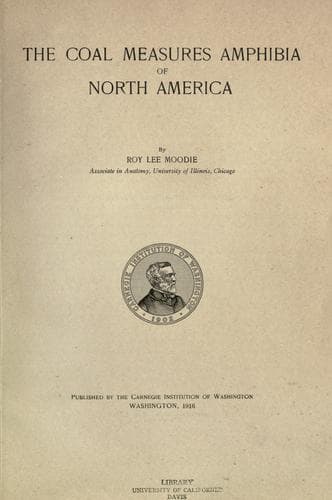
The Coal Measures Amphibia of North AmericaMoodie, Roy Lee
Science
The Coal Measures Amphibia of North America
Moodie, Roy Lee
Amphibians, Fossil -- North America; Paleontology -- Carboniferous; Paleontology -- North America
The fore limb is represented by the upper portions of the ulna and radius
and 2 digits of the right hand. The digits are long and slender and
seem to represent digits I and II, since they show evidences of 3 and 4
phalanges respectively. The portions of the forearm preserved are too
meager for description.
The vertebræ have already been characterized as of the type first
described in Urocordylus. The neural fans are not much, if any, wider than
the hæmal fans. They are both situated on an elongate spine with a slender
base. The edges of the two fans are pectinated and the dorsal spine is
distinguished by the presence of a longitudinal groove in the center of
the spine. The length of the tail may have been considerable, judging from
the character of the vertebræ preserved
Measurements.
mm.
Length of specimen 150
Width of belly, maximum 28
Length of lateral chevron plate 7
Width of lateral chevron plate 1.75
Length from tip of lateral chevron to median angle 10
Length of a caudal vertebra 10
Width of the same vertebra with spines 20
Height of neural spine 8
Height of hæmal spine 8
Width at distal end of hæmal spine 3
Width at distal end of neural spine 3.5
Length of foot, as preserved 12
=Genus LEPTOPHRACTUS Cope, 1873.=
Cope, Proc. Phila. Acad. Nat. Sci., p. 340, 1873.
Cope, Geol. Surv. Ohio, II, pt. II, p. 399, 1875.
Cope, Proc. Am. Phil. Soc., XX, p. 461, 1882.
Type: _Leptophractus obsoletus_ Cope.
The genus was established on various parts of the cranium of a large
amphibian. The only parts which can with certainty be referred to the
genus are the upper and lower jaws of 3 specimens. These bear large teeth,
round in section at the base, but with acute compressed apex, with a
cutting-edge on the anterior face; the enamel is delicately grooved, as an
external indication of the labyrinthic structure. A characteristic feature
is seen in the presence of a large elongate tooth in the upper jaw, in the
position of a canine which much exceeds in length any of the others. The
sculpture of the cranium is but little marked in the known specimens. In
the type the lower jaw is marked with inosculating grooves. Three species
are known, which are among the largest of the Linton Amphibia.
=Leptophractus obsoletus Cope.=
Cope, Proc. Phila. Acad. Nat. Sci., p. 340, 1873.
Cope, Geol. Surv. Ohio, II, pt. II, p. 399, 1875.
Cope, Proc. Am. Phil. Soc., XX, p. 461, 1882.
Type: Specimen Nos. 55 G and 57 G, American Museum of Natural History.
Horizon and locality: Linton, Ohio, Coal Measures.
Public-domain text, read in full here on John Shaqi.
Reviews
Reviews
No reviews yet
Be the first to share your thoughts on this work.
Elsewhere in the archive
Join the Discussion
Join the discussion
Sign in to leave a comment or review.
Sign InorCreate an account