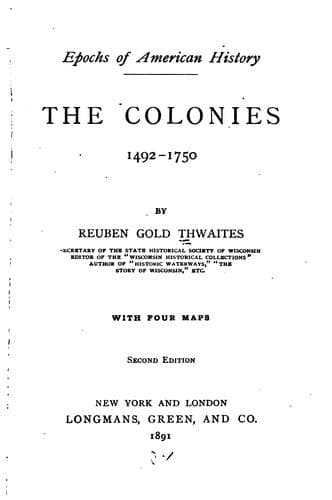
United States -- History -- Colonial period, ca. 1600-1775
The period of the decadence of the confederation, however, was in the main
one of prosperity for New England. Emigration to America had almost wholly
ceased after 1640, with the rise of the Puritans in England; but the
restoration of the Stuarts and the passage of the Act of Uniformity, with
its accompanying persecutions, caused a renewal of the departure of
Dissenters, and the movement included many, both laymen and clericals, of
eminent ability. New industries were introduced, commerce grew, the area of
settlement extended, and wealth increased.
Sidenote: Change of attitude towards England.
But the accretion of wealth and the passage of time brought changes in the
attitude towards England that threatened in a measure to counteract the
quiet struggle for independence which had been going on for nearly half a
century. A second generation of Americans had come upon the stage, with but
a traditional knowledge of the tyrannies practised upon their fathers in
the old country. Larger wealth secured greater leisure, which resulted in a
cultivation of the graceful arts, with a softening of the austere manners
and thinking of the first emigrants. There was now manifest a desire on the
part of many members of the upper class to bring about closer relations
with the Old World, with its fine manners, its aristocracy, and its
historic associations. Opposition to England began to give place to
imitation of England; colonial life had entered the provincial stage. Two
parties had by this time sprung up, although as yet without
organization,--one desiring to conciliate England, the other standing for
independence in everything except in name. Thus far none had ventured to
think of the possibility of dissolving all political connection with the
mother-land.
70. Indian Wars (1660-1678).
Sidenote: Indian policy of New England.
The Indian policy of the New Englanders was more humane than that adopted
in any of the other colonies except Pennsylvania. Compensation had been
granted to the savages for lands taken, firm friendships had been formed
between some of the chiefs and the whites, and the missionary enterprises
among the red-men were conducted on a large scale and with much zeal.
Martha's Vineyard, Cape Cod, and the country round about Boston were the
centres of proselytism; the "praying Indians" were gathered into village
congregations with native teachers, most notable being those under the
supervision of John Eliot, "the apostle." Of these converted Indians there
were in 1674 about four thousand; several hundred of them were taught a
written language invented by Eliot, who successfully undertook the
monumental labor of translating the Bible into it for their benefit.
Sidenote: Troubles with Philip.
Public-domain text, read in full here on John Shaqi.
Reviews
Reviews
No reviews yet
Be the first to share your thoughts on this work.
Elsewhere in the archive
Join the Discussion
Join the discussion
Sign in to leave a comment or review.
Sign InorCreate an account