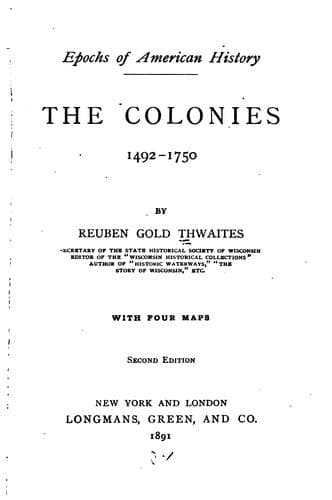
United States -- History -- Colonial period, ca. 1600-1775
With the death of Charles II. (1685), James II. came to the English throne.
As a Roman Catholic, and imbued with a taste of absolute power, the
colonies had little favor to expect from him. In 1686, as a step towards
abolishing the American charters, James sent over Sir Edmund Andros as
governor of Massachusetts, Plymouth, New Hampshire, and Maine; he brought
authority to ignore all local political machinery and to govern the country
through a council, the president of which was Joseph Dudley, the unpopular
Tory son of the stern old Puritan who had been Winthrop's lieutenant. The
charters of Rhode Island and Connecticut were demanded for annulment
(1686). The former colony was, as usual, obedient, and yielded up her
charter; Connecticut failed to respond to the demand of Andros, and he went
to Hartford (October, 1687) and ordered the charter to be produced. A
familiar myth alleges that the document was concealed from him in the
hollow trunk of a large tree, known ever after as the "charter oak;"
nevertheless Andros arbitrarily declared the colony annexed to the other
New England colonies which he governed.
Sidenote: His despotic rule.
The following year (1688) Andros was also made governor of New York and the
Jerseys, his jurisdiction now extending from Delaware Bay to the confines
of New France, with his seat of government at Boston. The government of
Andros was despotic, and fell heavily on a people who had up to this time
been accustomed to their own way. Episcopal services were held in the
principal towns, and Congregational churches were frequently seized upon
for the purpose; the writ of _habeas corpus_ was suspended; a censorship of
the press was restored, with Dudley as censor; excessive registry fees were
charged; arbitrary taxes were levied; land grants made under former
administrations were annulled; private property was unsafe from
governmental interference; common lands were enclosed and divided among the
friends of Andros; the General Court was abolished, and most popular rights
were ignored. Dudley tersely described the situation (1687) on the trial of
the Rev. John Wise, of Ipswich, for heading a movement in that town to
resent taxation without representation: "Mr. Wise, you have no more
privileges left you than not to be sold for slaves."
73. Restoration of the Charters (1689-1692).
Sidenote: Andros deposed.
In April, 1689, news came of the Revolution in England, the flight of the
arrogant James, and the accession of the Prince of Orange. The example of
revolt was already foreshadowed in Boston, where Andros and Dudley were
deposed. Elsewhere in the Northern colonies the representatives of the
tyrant extortioners were driven out. The Protestant sovereigns, William and
Mary, were proclaimed amid great popular rejoicings.
Sidenote: New England under William and Mary.
Public-domain text, read in full here on John Shaqi.
Reviews
Reviews
No reviews yet
Be the first to share your thoughts on this work.
Elsewhere in the archive
Join the Discussion
Join the discussion
Sign in to leave a comment or review.
Sign InorCreate an account