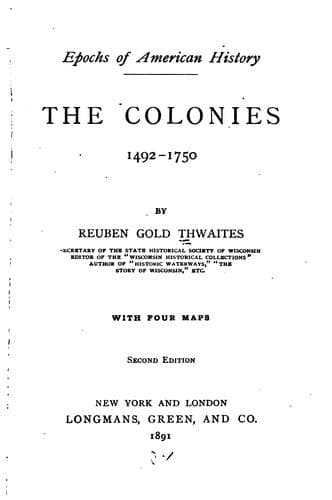
United States -- History -- Colonial period, ca. 1600-1775
Contemporary Accounts.--Whitbourne, _Discourse and Discovery of
Newfoundland_ (1620); Mason, _Brief Discourse of Newfoundland_ (1620); Du
Tertre, _Histoire Générale des Antilles_ (1654); Denys, _Description and
Natural History of Arcadia_ (1672); Labat, _Nouveau Voyage aux Isles
d'Amérique_ (1724); Oldmixon, _British Empire in America_ (1741); Dobbs,
_Countries adjoining to Hudson's Bay_ (1744); Ellis, _Voyage to Hudson Bay_
(1748); Hakluyt, _Voyages_. Reprints in publications of historical and
antiquarian societies.
99. Outlying English Colonies.
Sidenote: Differences between the thirteen colonies and their English
neighbors to the south and north.
It is usual to think and speak of the English colonies in North America as
though they included only the thirteen which, in 1775, revolted against the
mother-country. In the eyes of the home government, however, and of the
colonists themselves, the relations between the mother-land and the English
West India Islands, the Bermudas, Nova Scotia, Newfoundland, Hudson's Bay,
and, after 1763, Canada, were much the same as between it and Virginia or
New Hampshire or Pennsylvania. The chief differences between the colonies
were of race and occupation. Nova Scotia had, before the Revolution, but a
few thousand English inhabitants; the West Indies were almost exclusively
sugar-producing colonies. Both on the north and on the southeast the
English colonies touched elbows with the French in active commercial and
territorial competition. The West Indies were the emporium for sugar and
slaves, and an extensive traffic was had in both commodities with the
continental colonies. This important commerce has already been frequently
referred to, particularly in the treatment of New England (page 185, § 77),
whose vessels did the bulk of the colonial carrying trade.
Sidenote: Why those neighbors did not revolt against England.
Public-domain text, read in full here on John Shaqi.
Reviews
Reviews
No reviews yet
Be the first to share your thoughts on this work.
Elsewhere in the archive
Join the Discussion
Join the discussion
Sign in to leave a comment or review.
Sign InorCreate an account