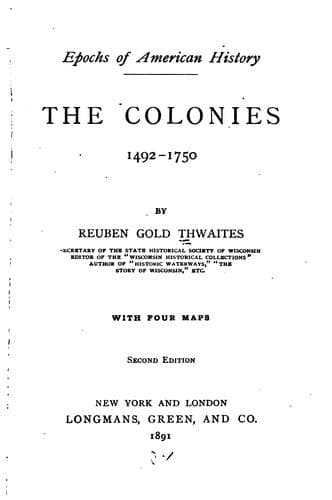
United States -- History -- Colonial period, ca. 1600-1775
Like other islands in the West Indies, Jamaica was resorted to by many Tory
planters from the continental colonies, and apparently had no sympathy with
the struggle of the latter for independence. It was a colony having a large
slave population, and after the separation of the continental colonies
became, to some degree, a competitor with them. The abolition of slavery in
the island (1830-1837) had a great influence on the slavery conflict in the
United States.
103. British Honduras (1600-1798).
Sidenote: Lawless character of English settlers.
Belize, or British Honduras, on the eastern shore of the Yucatan peninsula,
was not occupied by Englishmen until after the suppression of freebooting
in the Spanish main,--about the opening of the eighteenth century. At that
time parties of English dyewood and mahogany cutters, many of whom had been
pirates, established themselves at Belize. Their holdings were frequently
beset by rival Spanish logging companies, but in 1798 the latter were
expelled.
Sidenote: English rights questioned.
Since that day Belize has existed as a prosperous Crown colony, although
England's legal right to the country is still questioned by some
authorities, and in 1846 this fact gave rise to serious diplomatic
difficulties with the United States.
104. Newfoundland (1497-1783).
Sidenote: Early settlements.
Newfoundland is the oldest of the colonial possessions of Great Britain. We
have seen (page 25, § 8) that John Cabot discovered it in 1497, that
Cortereal was there for the Portuguese in 1500, and that by 1504 fishermen
from Normandy, Brittany, and the Basque provinces were regularly engaged on
its shores. It was the nucleus for both French and English occupation of
the mainland, and from the first an important fishery station.
Not until 1583 did the English take formal possession, and it was much
later before any of their numerous colonizing schemes attained any great
measure of success.
Sidenote: Growth of the colony.
By the treaty of Utrecht (1713) Newfoundland was acknowledged as English
territory, but the French were given fishing privileges on the western and
northern coasts. This led to diplomatic contentions, not yet ended;
nevertheless settlement at once increased, and a satisfactory growth has
since been maintained. In 1728, a form of civil government was for the
first time established.
Sidenote: Loyalty to England.
During the American Revolution Newfoundland had sufficient inducement to
remain loyal; since French and American competitors in the fisheries were
kept out by British fleets, her merchants had a monopoly of the European
markets, and were enabled to maintain high prices.
105. Nova Scotia, Acadia. (1497-1755).
Sidenote: French and English rivalry.
Public-domain text, read in full here on John Shaqi.
Reviews
Reviews
No reviews yet
Be the first to share your thoughts on this work.
Elsewhere in the archive
Join the Discussion
Join the discussion
Sign in to leave a comment or review.
Sign InorCreate an account