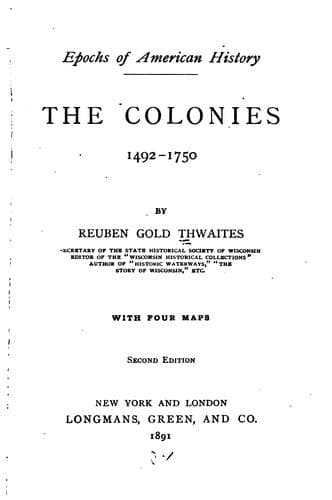
United States -- History -- Colonial period, ca. 1600-1775
At times, in Boston, excitement over this perennial quarrel ran to a high
pitch, and now and then it looked as though the assembly would be obliged
to yield; but the men of Massachusetts were of stubborn clay, and never
displayed more bravery than when the governor, backed by writs from
England, threatened them the loudest. In 1728, the assembly, defended
itself, saying it was "the undoubted right of all Englishmen, by Magna
Charta, to raise and dispose of money for the public service of their own
free accord, without compulsion." The Privy Council at last yielded the
point (1735), and left the Massachusetts governor free to receive whatever
the assembly chose to grant. In some of the colonies this salary question
resulted in frequent deadlocks, in which all public business was at a
standstill.
124. Governors of Southern Colonies.
Sidenotes: Other differences.
South Carolina's experience.
Other differences between the governors and their assemblies hinged on
claims of prerogative, fees for issuing land-titles, issues of paper money,
official attempts to favor the Church of England at the expense of
dissenters, and levies of men and money for the public defence. There were
also special grievances in many of the provinces. In South Carolina
(1704-1706), the proprietors attempted to exclude all but Church of England
men from the assembly. This led to a bitter controversy, in which the
dissenters successfully appealed to the House of Lords, and legal
proceedings were commenced by the Crown for the revocation of the Carolina
charter; but they were not then pushed to an issue. In 1719 the meddlesome
executive policy of the proprietors resulted in a popular uprising, in
which the governor was deposed. Later, the authorities (1754-1765)
attempted to resist the issue of paper money, and also to reduce
representation in the assembly, while at the same time the home government
introduced some offensive regulations regarding land patents. Popular
indignation again expressed itself in bloody turbulence, and the colony
fell into great disorder.
Sidenote: North Carolina.
In North Carolina the scattered colonists maintained a vigorous resistance
to arbitrary authority; the tone of official life was low; corruption in
office was common; contests over questions of public policy often led to
rioting and anarchy; bloodshed was not infrequent in such times of popular
disturbance. In the far western valleys there was for a long period no
pretence of law or order, and criminals of every sort found a safe refuge
there; while pirates--until Blackbeard's capture by Governor Spotswood of
Virginia in 1718--freely used the deep-coast inlets as snug harbors, from
which they darted out with rakish craft to attack passing merchant-vessels.
From 1704 to 1711 there was practically no government in the province,
owing to an insurrection headed by Thomas Carey, whom Governor Spotswood
finally arrested (1710) and sent prisoner to England.
Public-domain text, read in full here on John Shaqi.
Reviews
Reviews
No reviews yet
Be the first to share your thoughts on this work.
Elsewhere in the archive
Join the Discussion
Join the discussion
Sign in to leave a comment or review.
Sign InorCreate an account