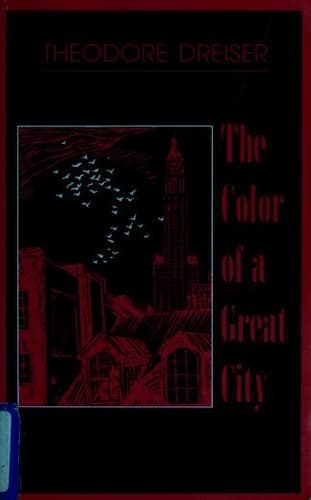
New York (N.Y.) -- Description and travel; New York (N.Y.) -- Social conditions
A glimmer appears through the transom overhead, where some one is
lighting the light. It sends a thrill of possibility through the
watchers. On the old hats and peaked shoulders snow is piling. It
gathers in little heaps and curves, and no one brushes it off. In the
center of the crowd the warmth and steam melt it and water trickles off
hat-rims and down noses, which the owners cannot reach to scratch. On
the outer rim the piles remain unmelted. Those who cannot get in the
center, lower their heads to the weather and bend their forms.
At last the bars grate inside, and the crowd pricks up its ears. There
is some one who calls: “Slow up there, now!” and then the door opens.
It is push and jam for a minute, with grim, beast silence to prove
its quality, and then the crowd lessens. It melts inward, like logs
floating, and disappears. There are wet hats and shoulders, a cold,
shrunken, disgruntled mass pouring in between bleak walls. It is just
six o’clock, and there is supper in every hurrying pedestrian’s face.
“Do you sell anything to eat here?” one questions of the grizzled old
carpet-slippers who opens the door.
“No, nuthin but beds.”
The waiting throng had been housed for the night.
THE MEN IN THE SNOW
Winter days in a great city bring some peculiar sights. If it snows,
the streets are at once a slushy mess, and the transaction of
business is, to a certain extent, a hardship. In its first flakes it
is picturesque; the air is filled with flying feathers and the sky
lowery with somber clouds. Later comes the slush and dirt, and not
infrequently bitter cold. The city rings with the grind and squeak of
cold-bitten vehicles, and men and women, the vast tide of humanity
which fills its streets, hurry to and fro so as to be through with the
work or need that keeps them out of doors.
In certain sections of the city at a period like this may be found
groups of men who are constituted by nature and conditions to be an
integral part of every storm. They are like the gulls that follow
the schools of fish at sea. Poverty is the bond which makes them kin
and gives them, after a fashion, a class distinction. They are not
only always poor in body, but poor in mind also, and as for earthly
belongings, of course they have not any.
Public-domain text, read in full here on John Shaqi.
Reviews
Reviews
No reviews yet
Be the first to share your thoughts on this work.
Elsewhere in the archive
Join the Discussion
Join the discussion
Sign in to leave a comment or review.
Sign InorCreate an account