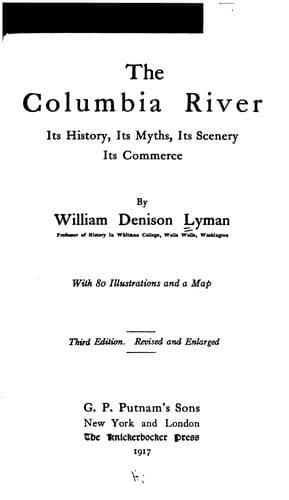
The Columbia River: Its History, Its Myths, Its Scenery, Its CommerceLyman, William Denison
History
The Columbia River: Its History, Its Myths, Its Scenery, Its Commerce
Lyman, William Denison
Columbia River; Columbia River -- Description and travel; Columbia River -- History
One of these was Hall J. Kelley of Boston. He was a native of New
Hampshire and a Harvard graduate. As early as 1815, when seventeen years
old, he conceived the idea of the colonisation of Americans in Oregon. He
was a man of high scholarship, philanthropic spirit, and patriotic
purpose. He was a dreamer and idealist, planning to form a community on
the Columbia, as one of the Utopias which minds of that stamp, from Plato
down, have been fond of locating somewhere in the unexplored West. After
making a great effort, with partial success, to enlist Congress in his
schemes, he succeeded in organising a company of several hundred, and by
1828 shaped the definite plan of going to St. Louis and following the
route of the fur companies across the plains to the River of Oregon. But
opposition by those same fur companies, and adverse criticism by the press
broke up his enterprise for that time. In 1832 he started with a small
party for the land of his dreams by the route through Mexico and
California. In California, he met with Ewing Young, an American of great
natural abilities and some education. Young and Kelley, brainy and
original men, the former from shrewd commercial instinct and the latter
from philanthropic dreams, formed a little company, and proceeded overland
from California to Oregon. This was in the autumn of 1834. When, after
some disasters, the company of eleven reached the Columbia, Young took up
a great tract of land in the Chehalem Valley, where he devoted himself to
stock-raising. Kelley, having become an invalid, went in distress to Fort
Vancouver, where Dr. McLoughlin treated him with kindness, though the
exclusive "Britishers" would not admit him to "social equality." The other
members of the company were scattered in various directions, but some of
them remained till American occupancy became an accomplished fact.
This company of 1834,--the same year that the Methodist missionaries
under Jason Lee arrived--may be considered the advance guard of American
immigration. Kelley, upon his return to New England by way of the Sandwich
Islands, disseminated much useful information about Oregon. To him,
without doubt, is to be attributed much of the subsequent wave of interest
which swept on toward American immigration. As first a New England college
man, educator, and social theoriser, and then a leader of the pioneer
movement to Oregon, Hall J. Kelley is worthy of permanent remembrance.
Public-domain text, read in full here on John Shaqi.
Reviews
Reviews
No reviews yet
Be the first to share your thoughts on this work.
Elsewhere in the archive
Join the Discussion
Join the discussion
Sign in to leave a comment or review.
Sign InorCreate an account