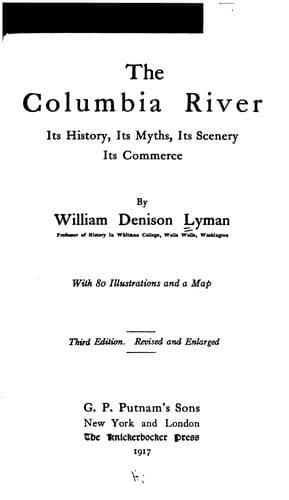
The Columbia River: Its History, Its Myths, Its Scenery, Its CommerceLyman, William Denison
History
The Columbia River: Its History, Its Myths, Its Scenery, Its Commerce
Lyman, William Denison
Columbia River; Columbia River -- Description and travel; Columbia River -- History
As it was too late to get the cattle back to Oregon that fall, the party
sold their schooner for three hundred and fifty cows, wintered in
California, and the next spring drove to the Columbia twelve hundred and
fifty head of cattle, six hundred head of mules and horses, and three
thousand sheep. This was an achievement which made the way for immigration
clearer than ever before, and in a most effective manner united the
American settlers with the American government. Some of the Hudson's Bay
Company people could begin to see the handwriting on the wall. Dr.
McLoughlin saw most quickly and most clearly, and as elsewhere narrated,
began to transfer his interests to the American side. This fine old man
was big-brained, big-bodied, and big-souled, a natural American, though
compelled to work for the British fur monopolists for the time. He admired
the independent spirit of the incoming Yankee immigrants, even when the
joke was on him. He afterwards told with much gusto of an American named
Woods crossing the Columbia to Vancouver to try to get goods. He found his
credit shaky, and somewhat piqued, he exclaimed: "Well, never mind, I
have an uncle back East rich enough to buy out the whole of your old
Hudson's Bay Company!" "Well, well, Mr. Woods," demanded the autocrat,
"who may this very rich uncle of yours be?" "Uncle Sam," was the unabashed
and characteristic American reply. "Old Whitehead" also appreciated,
though he was obliged to manifest a dignified disapproval, when two young
men from New York, having reached the fort on the River, were asked about
their passports. Laying their hands on their rifles they replied, "These
are an American's passports."
These small miscellaneous immigrations were in continuance from about 1830
to 1842. In the latter year a hundred came. In 1843, as elsewhere related,
the Provisional Government was instituted. At the very same time, the
immigration of 1843 was on its way to the River.
This immigration of 1843 was in many respects the most remarkable of all.
It was the first large one, and it was a type of all. It will be
remembered that Dr. Marcus Whitman had made his great winter ride in
1842-43 across the Rockies to St. Louis, with a double aim. First he
wished to see the officers of the American Board of Missions, and then to
enlist the American government and people in the policy of holding Oregon
against the manifest aims of the British. There was already a tremendous
interest felt in Oregon among the people of Missouri, Illinois, and the
other great prairie States. Whitman's opportune arrival and his announced
purpose to guide an immigration to the Columbia became widely known, and
brought to a focus many vaguely-considered plans.
J. W. Nesmith, subsequently one of the most prominent pioneers and a
member of each House of Congress from Oregon, has given a humorous account
of the manner of starting this immigration of 1843, of which he was a
member, which is so characteristic that we quote it here.
Public-domain text, read in full here on John Shaqi.
Reviews
Reviews
No reviews yet
Be the first to share your thoughts on this work.
Elsewhere in the archive
Join the Discussion
Join the discussion
Sign in to leave a comment or review.
Sign InorCreate an account