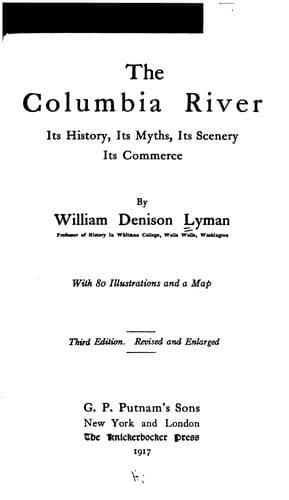
The Columbia River: Its History, Its Myths, Its Scenery, Its CommerceLyman, William Denison
History
The Columbia River: Its History, Its Myths, Its Scenery, Its Commerce
Lyman, William Denison
Columbia River; Columbia River -- Description and travel; Columbia River -- History
As we have seen, the many-named river, and the fact that it was the key to
a vast region and that the shores of the ocean contiguous to it seemed to
abound in the finest of furs, was a lure to Portuguese, Frenchman,
Russian, Spaniard, Englishman, and American. The first three became early
eliminated from the conflict, and the last three fought the triangular
battle to its ending with the final result that Uncle Sam inserted his
broad shoulders between Mexico and the 49th parallel, and thus controls
the choicest land of the sunset slope of the continent.
Spain, England, and the United States each had a valid claim to Oregon.
Spain, by the partial discovery of the River by Heceta in 1775, by the
voyages of Bodega and Arteaga in the same year and again in 1779, and by
the voyage of Valdez and Galiano around Vancouver Island in 1792, together
with many other voyages of a less definite nature by illustrious
navigators, as Malaspina, Bustamente, Elisa, and others, had a strong
position. Yet she had failed to clinch her discoveries or to take
effective possession.
Great Britain could point to the elaborate examinations of Cook and
Vancouver. The latter had made a minute investigation of the noble group
of waters whose outlet preserves the name of the old Greek pilot of
Cephalonia, Juan de Fuca; and his Lieutenant Broughton had entered the
Columbia River and proceeded over a hundred miles up the stream. The
nomenclature given to both the River and the Sound regions by Vancouver
had been the first in any sense complete. So England, too, had a strong
claim.
And what were the claims of the United States? First and foremost was the
discovery by Robert Gray of the River and his actual twenty-five-mile
ascension of it in May, 1792. He had gone much farther than Heceta, who
had only looked in, but he had not gone so far as Broughton. The latter
indeed, claimed, and his government followed him in the claim, that Gray
had not really been in the River at all, but was only in an estuary of the
sea into which the River flowed. But that, to any one who has seen the
River, is too much of a forced construction to stand serious examination.
Moreover, Gray antedated Broughton by some months.
Public-domain text, read in full here on John Shaqi.
Reviews
Reviews
No reviews yet
Be the first to share your thoughts on this work.
Elsewhere in the archive
Join the Discussion
Join the discussion
Sign in to leave a comment or review.
Sign InorCreate an account