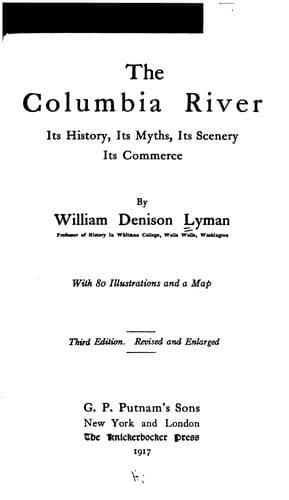
The Columbia River: Its History, Its Myths, Its Scenery, Its CommerceLyman, William Denison
History
The Columbia River: Its History, Its Myths, Its Scenery, Its Commerce
Lyman, William Denison
Columbia River; Columbia River -- Description and travel; Columbia River -- History
On the next day, November 29th, at about one o'clock, while Dr. Whitman
sat reading, a number of Indians entered the room. Having gained his
attention by the usual request for medicines, one of them, afterwards said
by some to have been Tamahas, and by others have been Tamsaky, rushed
suddenly upon the Doctor and struck his head with a tomahawk. Another
wretch named Telaukait, to whom the Doctor had been the kindest friend,
then cut and hacked the noble face of the philanthropist. The work of
murder thus inaugurated went on with savage energy. The men about the
mission were speedily slain, with the exception of a few who were in
remote places and managed by special fortune to elude observation. Mrs.
Whitman, bravely coming forward to succour her dying husband, was shot in
the breast and sank to the floor. She did not die at once, and it is said
by some of the survivors, then children, that she lingered some time,
being heard to murmur most tender prayers for her parents and children.
Mrs. Whitman was the only woman killed. The other women and girls were
cruelly outraged and held in captivity for several days.
William McBean was at that time in charge of the fort at Walla Walla, and
with a strange disregard of humane feelings, he shut the door of the fort
in the face of one of the escaped Americans, and a little later served the
Osborne family in the same manner. McBean sent a courier down the River to
convey the tidings to Vancouver, but this courier did not even stop at The
Dalles to warn the people, though they were not attacked. James Douglas
was then chief factor at Vancouver, as successor to Dr. McLoughlin. As
soon as he was apprised of the massacre, he sent Peter Skeen Ogden with a
force to rescue the survivors. Ogden acted with promptness and efficiency,
and by the use of several hundred dollars' worth of commodities ransomed
forty-seven women and children. Thirteen persons had been murdered.
One of the most distressing experiences was that of the Osborne family. Of
this Mr. Osborne says:
Public-domain text, read in full here on John Shaqi.
Reviews
Reviews
No reviews yet
Be the first to share your thoughts on this work.
Elsewhere in the archive
Join the Discussion
Join the discussion
Sign in to leave a comment or review.
Sign InorCreate an account