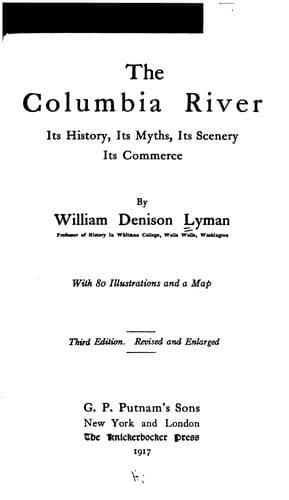
The Columbia River: Its History, Its Myths, Its Scenery, Its CommerceLyman, William Denison
History
The Columbia River: Its History, Its Myths, Its Scenery, Its Commerce
Lyman, William Denison
Columbia River; Columbia River -- Description and travel; Columbia River -- History
When first organised in 1860, the Oregon Steam Navigation Company had a
nondescript lot of steamers, mainly small and weak. The two portages, one
of five miles around the Cascades and the other of fourteen miles from The
Dalles to Celilo Falls, were unequal to their task. The portages at the
Cascades on both sides of the River were made by very inadequate wooden
tramways. That at The Dalles was made by teams. Such quantities of freight
were discharged from the steamers that sometimes the whole portage was
lined with freight from end to end. The portages were not acquired by the
company with the steamboat property, and as a result the portage owners
reaped the larger share of the profits. During high water the portage on
the Oregon side at the Cascades had a monopoly of the business, and it
took one-half the freight income from Portland to The Dalles. This was
holding the whip-hand with a vengeance, and the vigorous directors of the
steamboat company could not endure it. Accordingly, they absorbed the
rights of the portage owners, built a railroad from Celilo to The Dalles
on the Oregon side, and one around the Cascades on the Washington side.
The company was reorganised under the laws of Oregon in October, 1862,
with a declared capitalisation of two million dollars.
Business on the River in 1863 was something enormous. Hardly ever did a
steamer make a trip with less than two hundred passengers. Freight was
offered in such quantities at Portland that trucks had to stand in line
for blocks, waiting to deliver and receive their loads. New boats were
built of a much better class. Two rival companies, the Independent Line
and the People's Transportation Line, made a vigorous struggle to secure a
share of the business, but they were eventually overpowered. Some
conception of the amount of business may be gained from the fact that the
steamers transported passengers to an amount of fares running from $1000
to $6000 a trip. On April 29, 1862, the _Tenino_, leaving Celilo for the
Lewiston trip, had a passenger load amounting to $10,945, and a few trips
later reported receipts of $18,000, for freight, passengers, meals, and
berths. The steamships sailing from Portland to San Francisco showed
equally remarkable records. On June 25, 1861, the _Sierra Nevada_ conveyed
a treasure shipment of $228,000; July 14th, $110,000; August 24th,
$195,558; December 5th, $750,000. The number of passengers carried on The
Dalles-Lewiston route in 1864 was 36,000 and the tons of freight were
21,834.
Public-domain text, read in full here on John Shaqi.
Reviews
Reviews
No reviews yet
Be the first to share your thoughts on this work.
Elsewhere in the archive
Join the Discussion
Join the discussion
Sign in to leave a comment or review.
Sign InorCreate an account