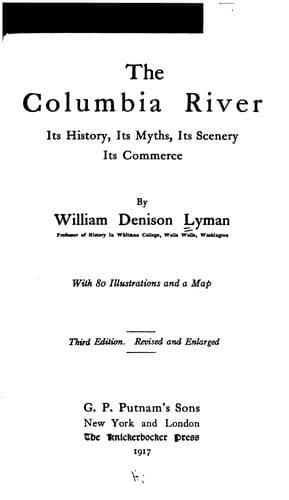
The Columbia River: Its History, Its Myths, Its Scenery, Its CommerceLyman, William Denison
History
The Columbia River: Its History, Its Myths, Its Scenery, Its Commerce
Lyman, William Denison
Columbia River; Columbia River -- Description and travel; Columbia River -- History
One of these so well illustrates those old-time conditions that we repeat
here its chief points. Captain Armstrong owned two steamers, the _Ruth_
and the _Gwendoline_. Both were engaged in transporting freight by way of
Jennings to Fort Steele and the various mining camps in that district. The
business was enormously profitable, for the boats received two and one
half cents a pound. At that particular time there were twenty-six cars on
the Great Northern Railway awaiting shipments.
From his two steamers Captain Armstrong sometimes made two thousand
dollars a day in gross receipts. But though profitable, the business was
also correspondingly risky. The Jennings Canyon, above Bonner's Ferry, is,
perhaps, the worst piece of water that has ever been navigated on the
Columbia or its tributaries. A strip of water, foaming-white, down-hill
almost as on a steep roof, hardly wider than the steamboat, savage-looking
rocks waiting to catch hold of any unwary craft that might venture
through,--so forbidding in fact was that route that Captain Armstrong
found no insurance agent that felt disposed to insure his boats and cargo.
At last he induced a San Francisco agent to make the trip with him and
to offer a rate. After sitting in silence on the deck while the steamer
whirled down the Jennings Canyon, the agent stated that his rate would be
twenty-five per cent. of the cargo. The daring captain decided to take the
risk himself. He had made a number of trips with entire success and
immense profit. But just at the height of the season, when the twenty-six
cars were on the track and a sack full of gold was waiting for him, the
captain got into too much of a hurry. He was running the _Gwendoline_; one
of his best pilots, the _Ruth_. The _Ruth_ was ahead. Both were making
their best possible time down the canyon to get a cargo. Captain Armstrong,
at the wheel of the _Gwendoline_, was whizzing down the canyon at a rate
which made stopping impossible, when to his dismay he saw the _Ruth_ right
ahead of him in a narrow turn, lying across the channel, wedged in the
rocks. To stop was impossible. To select any comfortable landing-place was
equally so. The _Gwendoline_ piled right on top of the _Ruth_. Both were
total wrecks, without a dollar of insurance. A two-thousand-dollar cargo
gone in five minutes, to say nothing of boats and business that could not
be replaced and a fortune within grasp that would never be so near again.
[Illustration: Lake Windermere, Upper Columbia, where David Thompson's
Fort was Built in 1810. Photo. by W. D. Lyman.]
But such were the risks of steamboating on the Kootenai.
Public-domain text, read in full here on John Shaqi.
Reviews
Reviews
No reviews yet
Be the first to share your thoughts on this work.
Elsewhere in the archive
Join the Discussion
Join the discussion
Sign in to leave a comment or review.
Sign InorCreate an account