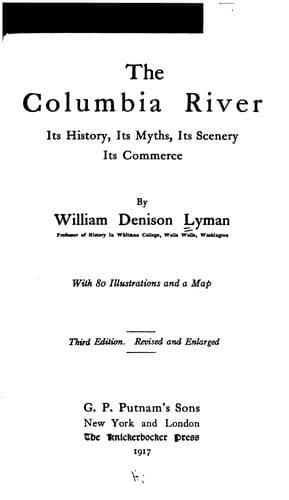
The Columbia River: Its History, Its Myths, Its Scenery, Its CommerceLyman, William Denison
History
The Columbia River: Its History, Its Myths, Its Scenery, Its Commerce
Lyman, William Denison
Columbia River; Columbia River -- Description and travel; Columbia River -- History
We pass several rapids on this section of the River, the chief of which
are the Umatilla, John Day, and Hell-gate. These are somewhat serious
impediments to navigation at low water. The Umatilla Rapid presents the
curious feature of a reef extending almost directly across the River with
the channel running parallel to it and at right angles to the course of
the stream. Hence when the water is so low that the reef cannot be passed
directly over, the steamer pilot must follow a channel running right
across the current, a current which tends to throw him broadside onto the
reef. The Government is at present engaged in blasting a channel
directly through this reef. The country becomes more rugged as we descend,
and at various points, if the sky be clear, we can see the great peaks of
the Cascades to the west. Passing through the wild water of Hell-gate,
where the steamer quivers as though great hands were reaching up from
below and shaking her, we soon find ourselves at Celilo.
[Illustration: Witch's Head, near Old Wishram Village. The Indian
Superstition Is that these Eyes will Follow Any Unfaithful Woman. By
Courtesy of Major Lee Moorehouse.]
This is the beginning of the greatest series of obstructions on the River
and the point where the Government is now constructing a canal, by means
of which the entire upper course of the River will be brought into
connection with the lower. In the distance of twelve miles the River falls
eighty-one feet at low water and sixty feet at high water. The Tumwater
Falls at the head of this series of obstructions has a descent of twenty
feet at low water, but at high water the volume of the River is so great
that it passes directly over the fall and a boat can shoot over the steep
slope. Here was one of the most famous places in early history. On the
north side was the Wishram village, noted in Irving's _Astoria_. This,
too, was the greatest place for fishing on the upper River. Even now the
Indians gather in autumn in great numbers and can be seen spearing the
salmon. Several immense fish-wheels also can be seen upon the verge of the
falls.
The most remarkable of all these obstructions is Five-Mile Rapids. This is
the place to which in the first place the French _voyageurs_ applied the
name _Dalles_, meaning a trough through the flat plates of rock. It is
sometimes called the "Big Chute."
Public-domain text, read in full here on John Shaqi.
Reviews
Reviews
No reviews yet
Be the first to share your thoughts on this work.
Elsewhere in the archive
Join the Discussion
Join the discussion
Sign in to leave a comment or review.
Sign InorCreate an account