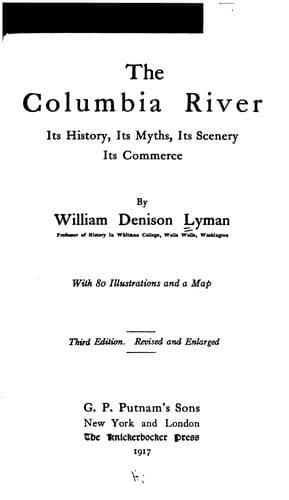
The Columbia River: Its History, Its Myths, Its Scenery, Its CommerceLyman, William Denison
History
The Columbia River: Its History, Its Myths, Its Scenery, Its Commerce
Lyman, William Denison
Columbia River; Columbia River -- Description and travel; Columbia River -- History
A fitting introduction to this stage of our journey is found in Paha
Cliffs at the mouth of the Klickitat, a perpendicular bastion of lava
rock, not remarkable for height, but of such regularity and symmetry as to
seem the work of men's hands. A short distance below the Paha Cliffs, also
on the Washington side of the river, is a most singular semicircular wall
of gigantic area, surrounding on the west what seems to be an immense
sunken enclosure. The Indians have a story to the effect that once
Speelyei, being on his way up the river before this wall existed, paused
here to perform some unworthy deed (for Speelyei was a curious mixture of
the noble and the base). Having done the deed, he began to fear that it
would become known. So he hurriedly built a wall to keep in the report.
But while he was engaged in building on the west, the report got out on
the east. The wall that we now see is the remains of his building. Of a
similar order of Indian fancy is the "Baby-on-the-Board" and the "Coyote
Head" farther down the river, also on the north side. The Coyote Head is
near White Salmon. It commemorates the transformation of a presumptuous
Klickitat chief who wished to proclaim himself equal to Speelyei, so he
crowned himself with a coyote skin and took his station on the great rock
wall above the mouth of the White Salmon. And there he remains still, for
Speelyei with a wave of the hand transformed the offending chieftain into
rock.
[Illustration: Steamer _Dalles City_ Descending the Cascades of the
Columbia.]
A few miles below the mouth of the Klickitat, there stands in mid-channel
one of the most curious and interesting objects on the river, "Memaloose
Island." This desolate islet of basalt was one of the most noted of the
frequent "death" or burial places of the Indians. They were accustomed to
build platforms and place the dead upon them. Apparently this island was
used for its gruesome purpose for centuries. A large white marble monument
facing the south attracts the attention of all travellers, and as we pass
we see that it is sacred to the memory of Vic Trevett. He was a prominent
pioneer of The Dalles, and in the course of his various experiences became
a special friend of the Indians, who looked upon him with such love and
reverence that when his end approached he gave directions that his
permanent burial-place and monument should be on the place sacred to his
aboriginal friends.
Public-domain text, read in full here on John Shaqi.
Reviews
Reviews
No reviews yet
Be the first to share your thoughts on this work.
Elsewhere in the archive
Join the Discussion
Join the discussion
Sign in to leave a comment or review.
Sign InorCreate an account