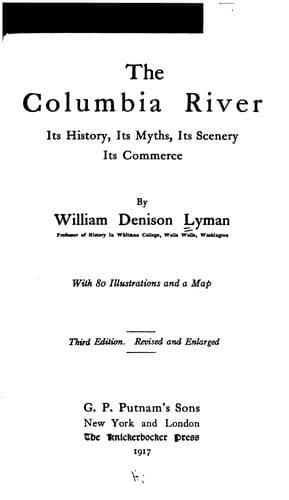
The Columbia River: Its History, Its Myths, Its Scenery, Its CommerceLyman, William Denison
History
The Columbia River: Its History, Its Myths, Its Scenery, Its Commerce
Lyman, William Denison
Columbia River; Columbia River -- Description and travel; Columbia River -- History
a mere speck, yet distinctly discernible, two hundred miles distant. One
unaccustomed to the mountains would not believe it possible that such an
area could be caught within the vision from a single point.
[Illustration: Lake Chelan. Photo. by F. N. Kneeland.]
It may be understood that the description of one of our great snow-peaks
is, in general terms, a description of all. With every one there are the
same azure skies, the same snow-caps, the same crevassed and glistening
rivers of ice, the same long ridges with their intervening grassy and
flowery meads, purling streams, and reflecting lakes. With the name of
each there rises before Mazama or Mountaineer the remembrance of the camp
of clouds or stars upon the edge of snow-bank, the sound of the bugle at
two o'clock in the morning of the great climb, the hastily swallowed
breakfast of coffee and ham, while climbers stand shivering around the
flickering morning fire, the approaching day with its banners of crimson
behind the heights, the daubing of faces with grease-paint and the
putting on of goggles, amid shouts of laughter from each at the grotesque
and picturesque ugliness of all the others, then the hastily grasped
alpenstocks, the forming in line, and at about four o'clock, while the
first rays of the sun are gilding the summit, the word of command and the
beginning of the march.
Each great peak has its zones, so significant that each seems a world in
itself. There is first the zone of summer with its fir and cedar forests
at the base of the peak, from a thousand feet to twenty-five hundred above
sea-level. In the case of most of our great peaks this zone consists of
long gentle slopes and dense forests, with much undergrowth, though on the
eastern sides there are frequently wide-open spaces of grassy prairie.
Then comes the zone of pine forest and summer strawberry, with its
fragrant air and long glades of grass and open aisles of columned trees,
"God's first temples," pellucid streams babbling over pebbles and white
sands, and occasionally falling in cascades over ledges of volcanic rock.
This zone rises in terraces which attest the ancient lava flow, at an
increasing grade over the first, though at most points one might still
drive a carriage through the open pine forests. Then comes the third zone,
a zone of parks. The large pine trees now give way to the belts of
subalpine fir and mountain pine and larch, exquisite for beauty, enclosing
the parks and grouped here and there in clumps like those in some old
baronial estate of feudal times. This is the zone of rhododendron,
shushula, phlox, and painted brush. Through the open glades the ptarmigan
and deer wander, formerly unafraid of man, but now, alas, under the ban
of civilisation. The upward slope has now increased to twenty or
twenty-five degrees, and to a party of climbers a frequent rest and the
quaffing of the ice-cold stream that dashes through the woods afford a
happy feature of the ascent.
Public-domain text, read in full here on John Shaqi.
Reviews
Reviews
No reviews yet
Be the first to share your thoughts on this work.
Elsewhere in the archive
Join the Discussion
Join the discussion
Sign in to leave a comment or review.
Sign InorCreate an account