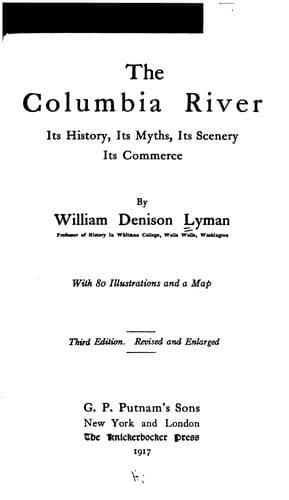
The Columbia River: Its History, Its Myths, Its Scenery, Its CommerceLyman, William Denison
History
The Columbia River: Its History, Its Myths, Its Scenery, Its Commerce
Lyman, William Denison
Columbia River; Columbia River -- Description and travel; Columbia River -- History
Having returned from our side trip to the mountain peaks of Hood and Adams
and having resumed our station on the bank of the River just below Rooster
Rock, we see that we are now in a new world. We are at sea-level. Dense
forests clothe the shores, except for the places where the axe of the
settler or the saws of the lumberman have made inroads. Moss drapes the
rocks. Ferns and vines take possession wherever the trees have been
removed. Even in summer a feeling of humidity usually pervades the air. A
certain softness and roundness seems to characterise both the vegetable
and animal world. The smell of the sea is in the atmosphere, even though
the sea is yet distant. No longer do our eyes wander over boundless
expanses of rolling prairie, crowned to the highest knolls with
wheat-fields, as on the other side of the mountains. The mountains fall
away, and low bottoms, sometimes oozy with the inflowing river or the
creeks from the forests, stretch away in the lazy, hazy distance. The
River no longer flows tumultuously and with that militant energy which is
so characteristic of the long stretches from Kettle Falls to The Dalles.
It has a calm and stately majesty, the repose of accomplished warfare and
victory. It has hewn its way down to the level of the ocean and no longer
needs to fret and storm. It has conquered a peace.
[Illustration: Band of Elk on W. P. Reser's Ranch, Walla Walla, Wash.
Photo. by W. D. Chapman.]
Below Rooster Rock, the shores are flats with low hills in the background,
and the River expands to a width of from one to two miles. If we still
imagine ourselves in a small boat, we find the most delightful of
sensations in gliding past the grassy islands and shores thick with fir or
cottonwood. Or if we choose to take our way to one of the elegant
steamers, _Spencer_ or _Bailey Gatzert_, we shall still partake of the
same life and feel the same sense of repose and contentment which belong
by natural right to this portion of the River.
Soon after leaving Rooster Rock, we begin to pass frequent pleasant farms
on either bank. On the Washington side we see two pretty villages,
Washougal and La Camas. The first has the historical distinction of being
at or nearly at the highest spot reached by the English explorer Broughton
in 1792, and named by him Point Vancouver. La Camas is the location of the
most extensive paper mills in the North-west.
Public-domain text, read in full here on John Shaqi.
Reviews
Reviews
No reviews yet
Be the first to share your thoughts on this work.
Elsewhere in the archive
Join the Discussion
Join the discussion
Sign in to leave a comment or review.
Sign InorCreate an account