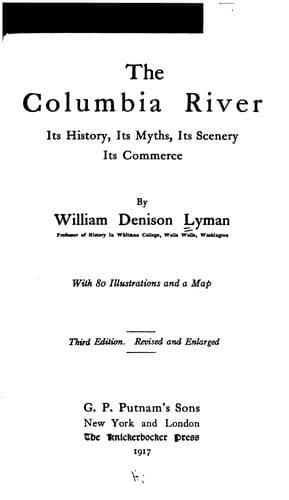
The Columbia River: Its History, Its Myths, Its Scenery, Its CommerceLyman, William Denison
History
The Columbia River: Its History, Its Myths, Its Scenery, Its Commerce
Lyman, William Denison
Columbia River; Columbia River -- Description and travel; Columbia River -- History
But now all these scenes and vistas must be left behind, and we must pass
between the capes. The long sandspit of Point Adams lies on the south, and
the bold rock-promontory of Cape Hancock on the north, seven miles apart,
each crowned with a lighthouse. Between them we secure a view of the great
jetty in course of construction by the Federal Government. This is one of
the most important improvements in connection with the River. When this
work, together with the canal and locks at Celilo, is completed, the River
may be regarded as really navigable on a large scale. The work on the
jetty was inaugurated soon after the jetty-building by Captain Eads at the
mouth of the Mississippi River had drawn the favourable attention of
people and Government to this method of deepening river mouths. The
jetty consists of a double line of piling, filled with rock and mattresses
of woven willows. This constitutes a solid core against which the current
of the River on one side piles the silt, while on the other the ocean
waves pound the sand into a permanent barrier-reef. The philosophy of it
is so to narrow the entrance that the accelerated current of the River
will scour out the channel to an increased depth. Piles have been set in
place by an ingenious system of pneumatic pipes by which compressed air
bores a hole in the sand. Into this hole the pile is dropped, and the
sea-waves in a moment fill in and tamp the sand around it. Thus the ocean
is made to fence itself out. Upon the jetty a railroad has been built, and
a train, loaded with rock and willows, runs out on this every eleven
minutes for dumping material into the space between the piles. Very
gratifying results have already been secured. There is now a depth of
twenty-six feet on the Bar at low water. The crest of the Bar has been cut
much deeper at several narrow points, and this indicates the progress that
may be expected. It is hoped that the completed jetty will maintain a
permanent channel of forty feet at low water. In stormy weather the work
on the jetty is difficult and dangerous. The impact of the Pacific waves
when lashed by a sixty-mile "sou'-wester" is something terrific. Large
sections of piling have been torn out, and much loss has resulted. But
patience and money triumph over all obstacles, and the work goes steadily
on. Some conception of the magnitude of the commerce to be accommodated by
this great work may be formed from the fact that in the year 1907 the
freight handled on the lower River by both river and ocean vessels
amounted to 4,251,681 tons, valued at $76,583,804. This is but a fraction
of what will come with the full development of the Columbia Valley and
with the needed improvements to navigation. The Federal Government
maintains life-saving stations on both sides of the River. Many a tale of
daring could these heroes of the beach tell, should we stop to question
them.
Public-domain text, read in full here on John Shaqi.
Reviews
Reviews
No reviews yet
Be the first to share your thoughts on this work.
Elsewhere in the archive
Join the Discussion
Join the discussion
Sign in to leave a comment or review.
Sign InorCreate an account